

🧰 SAP Service Management interview guide
S/4HANA Service and classic Customer Service (CS), from request and entitlement to confirmation, billing and profitability. Includes field service integration and a scored test.
SAP Service Management runs after-sales and field service: repairs, installations, maintenance contracts, warranty claims and in-house repairs. Today there are two flavours you must be able to compare in interviews: classic Customer Service (CS), built on the PM objects, and SAP S/4HANA Service, which brings the CRM one-order service model natively into S/4HANA. Both follow a Service-to-Cash cycle.
📝 Jump to the scored Service Mgmt test
What is SAP Service Mgmt?
Classic CS uses service notifications (S1, S2, S3), service orders (such as SM01 and SM02) on PM technology, service contracts in SD (VA41), warranty and resource-related billing (DIP profile, DP90).
SAP S/4HANA Service uses business transactions (service requests, quotations, service orders, service confirmations, service contracts, in-house repair and solution orders), service products, SLAs and entitlement, with Fiori apps and standard integration to SAP Field Service Management (FSM).
Service types to know: field service, in-house (depot) repair, contract-based preventive service, warranty service and bundled solutions combining products, services and subscriptions.
End-to-end process: Service-to-Cash
Walk the panel through the cycle and, at each step, say how it works in S/4HANA Service and in classic CS. This comparison is a favourite senior-level question.
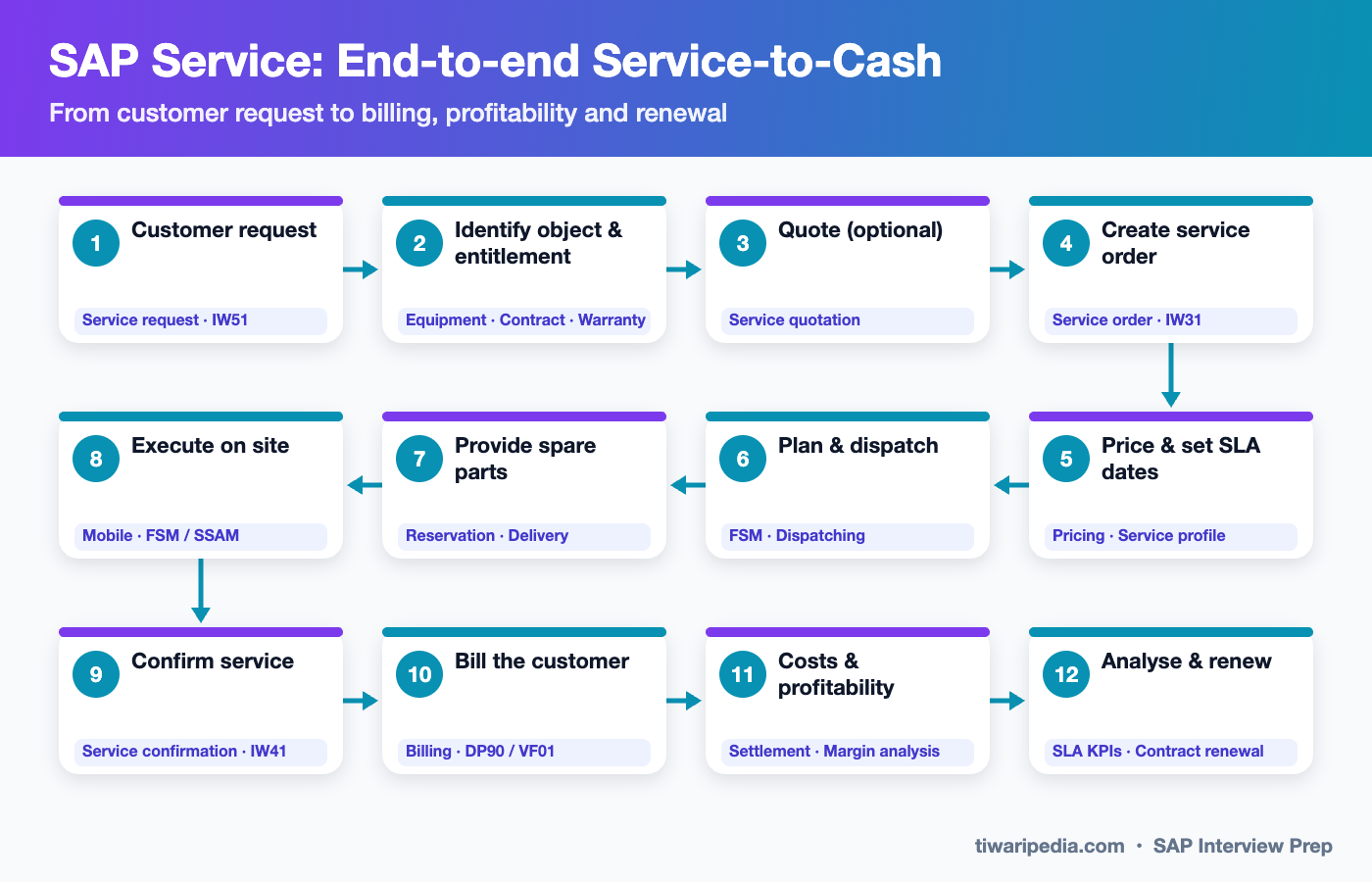
- Customer request
Service request · IW51
The customer reports an issue through phone, portal or email. S/4HANA Service creates a service request; classic CS creates a service notification (S1, S2 or S3). - Identify object & entitlement
Equipment · Contract · Warranty
Identify the technical object (equipment and serial number) and check entitlement: service contract, warranty and SLA response times. - Quote (optional)
Service quotation
Prepare a quotation for chargeable work with service products, spare parts and expenses. Customer acceptance converts it to an order. - Create service order
Service order · IW31
The order holds service items, spare part items and expense items. In CS, the order type (such as SM02) carries revenue planning. - Price & set SLA dates
Pricing · Service profile
Pricing applies contract or price agreement conditions. SLA dates (first response, solution) are calculated from service and response profiles. - Plan & dispatch
FSM · Dispatching
Assign the technician by skills, location and availability, often in SAP Field Service Management with replication from S/4HANA. - Provide spare parts
Reservation · Delivery
Spare parts are issued from the warehouse or van stock, or procured through PRs for non-stock parts. - Execute on site
Mobile · FSM / SSAM
The technician performs the job, records time, parts, expenses and checklists, and captures the customer signature on mobile. - Confirm service
Service confirmation · IW41
The confirmation posts actual time, materials and expenses, with costs flowing to the controlling object. - Bill the customer
Billing · DP90 / VF01
Billing is based on confirmations (S/4HANA Service billing) or resource-related billing with a DIP profile (CS). Warranty work is not charged. - Costs & profitability
Settlement · Margin analysis
Revenues and costs land in CO-PA / margin analysis. Classic CS settles the order with KO88; S/4HANA Service posts in real time. - Analyse & renew
SLA KPIs · Contract renewal
Track first-time fix rate, SLA compliance and contract profitability, then renew or upsell service contracts.
Organizational structure & master data
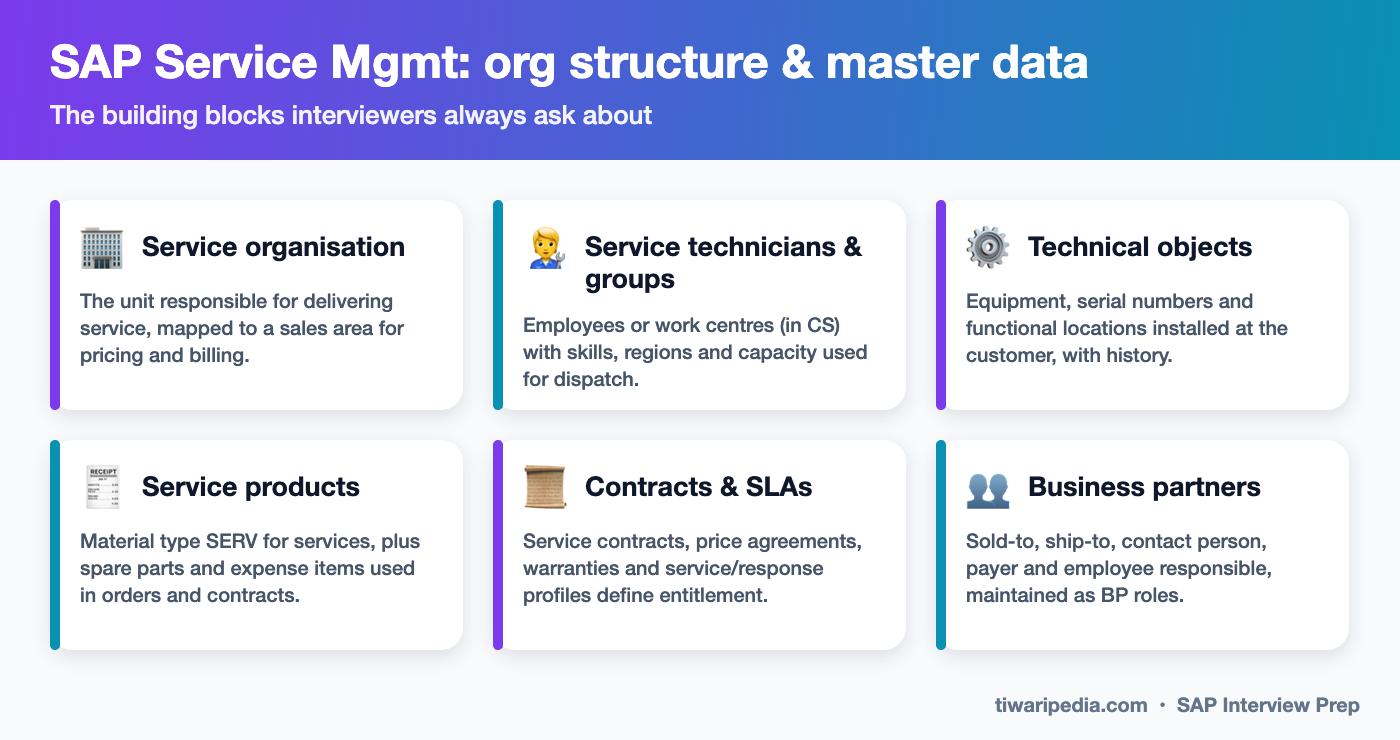
Organizational structure
Sales area
Sales org, distribution channel and division used for pricing, billing and contracts in both CS and S/4HANA Service.
Service organisation (S/4HANA Service)
Maintained in the organisational model with the service function and determined in transactions through org determination rules.
Maintenance planning plant and work centres (classic CS)
CS orders are planned in a planning plant with work centres and activity types for labour costing.
Company code & controlling area
Determine where service revenue and costs are posted.
Service teams and territories
Used for responsibility, routing and dispatch, often managed in FSM.
Master data
Business Partner
Customer roles plus contact person and employee (technician) roles.
Service products (SERV)
Services with service-specific attributes, duration and unit of measure. Product categories for S/4HANA Service.
Technical objects
- Equipment (IE01) with serial number (IQ01)
- Functional locations for site-based service
- Installed base / object hierarchies
Contracts & warranty
- Service contracts with SLA and price agreements
- Warranty master (BGM1) assigned to equipment
- Service and response profiles
Pricing
Condition records for service products, labour rates, contract discounts and expenses.
DIP profile (classic CS)
Controls resource-related billing: which costs (by cost element) become which billable material and how they are summarised.
Key T-codes & Fiori apps
Interviewers often ask you to name the transaction or app for a step. You do not need to memorise hundreds, but you should know these confidently.
| T-code / App | What it does |
|---|---|
| IW51 / IW52 / IW53 | Create / change / display service notification (CS) |
| IW31 / IW32 / IW33 | Create / change / display service order (CS order types like SM01, SM02) |
| IW72 / IW73 | Service order list change / display |
| IW41 | Order confirmation |
| DP90 / DP91 | Resource-related billing for service order / sales order |
| ODP1 | Maintain DIP profile |
| VA41 / VA42 | Create / change service contract (CS, SD contract) |
| BGM1 | Create master warranty |
| IE01 / IQ01 | Create equipment / serial number |
| KO88 | Settle service order |
| Fiori (S/4HANA Service): Manage Service Orders, Manage Service Contracts, Manage Service Confirmations, Manage In-House Repairs, Manage Service Quotations | S/4HANA Service business transactions |
What changed in S/4HANA
- SAP S/4HANA Service brings CRM-based service processes (one-order model) into the S/4HANA core, with business transactions for service requests, quotations, orders, confirmations, contracts, in-house repair and solution orders.
- No separate CRM system or middleware replication is needed: master data (BP, products, technical objects) is shared in one system.
- Classic CS remains available in S/4HANA, so many customers run CS processes and adopt S/4HANA Service gradually.
- Real-time financials: service transactions post costs and revenues through the Universal Journal, and event-based revenue recognition supports service orders and contracts.
- Standard integration with SAP Field Service Management for scheduling and mobile execution, and with SAP Service Cloud for customer engagement.
- Solution quotations and solution orders combine products, services and subscriptions, with BRIM for usage-based and recurring billing.
Integration points
| With | How it integrates |
|---|---|
| SD | Sales area, pricing, contracts (classic CS) and billing documents. Spare parts sales via sales orders. |
| PM / EAM | Classic CS reuses PM technical objects, notifications, orders, task lists and maintenance plans for contract-based preventive service. |
| MM / EWM | Spare parts reservations, van stock, procurement of non-stock parts and returns of defective parts. |
| FI / CO | Costs and revenues post to the service order or controlling object, then to margin analysis. RRB uses cost elements mapped in the DIP profile. |
| SAP FSM | Service orders and technician assignments replicate to FSM. Confirmations, time and parts come back to S/4HANA. |
| SAP Service Cloud / CX | Customer tickets and case management flow into S/4HANA service orders. |
| BRIM / Subscription | Recurring and usage-based charges for service contracts and bundled solutions. |
Interview questions & answers
Tap a question to see a model answer. They are grouped from fundamentals to scenario-based questions that senior panels love.
🟢 Fundamentals
What is the difference between classic CS and S/4HANA Service? Beginner
What are the service notification types in classic CS? Beginner
Explain the difference between service order types SM01 and SM02. Beginner
What is resource-related billing (RRB)? Beginner
What is a service contract? Beginner
What is warranty in SAP service? Beginner
🟡 Intermediate
How are SLAs handled in S/4HANA Service? Intermediate
What item types does a service order in S/4HANA Service have? Intermediate
How does billing work in S/4HANA Service? Intermediate
What is in-house repair? Intermediate
How does contract-based preventive service work in classic CS? Intermediate
How do costs and revenues flow in service management? Intermediate
🔴 Scenario & design
A customer wants technicians to use a modern mobile app with smart scheduling. What do you propose? Scenario
A customer is on SAP CRM Service and ECC CS. What is your S/4HANA roadmap? Scenario
Billing amounts on a service order are wrong after RRB. How do you troubleshoot? Scenario
How would you design warranty claims against the original manufacturer? Scenario
How do you handle a service contract with quarterly fixed fees plus chargeable extra visits? Scenario
Which KPIs matter for a service business? Scenario
How would you handle spare parts for field technicians? Scenario
Solution architect view
Key Service Management design decisions:
- Platform choice: S/4HANA Service, classic CS, or a phased coexistence. Base it on process needs (SLA, contracts, solution orders), CRM history and roadmap.
- Service portfolio: service products, item categories and transaction types for field service, in-house repair, contract and warranty work.
- Entitlement model: contracts, warranties, SLA profiles and price agreements, and how they are determined automatically.
- Field execution: SAP Field Service Management or SAP Service and Asset Manager for scheduling and mobile.
- Commercials: fixed price, time and material (RRB), periodic contract billing, and subscription/usage billing with BRIM.
- Finance: controlling objects, margin analysis and event-based revenue recognition.
- Front office: SAP Service Cloud integration for case management and the customer portal.
Typical deliverables: Service-to-Cash process design, transaction type and item category matrix, SLA and entitlement design, FSM integration specification, and the billing and revenue recognition design.
Test yourself: scored Service Mgmt quiz
Interview tips
- Always compare classic CS and S/4HANA Service. Panels love this question.
- Explain RRB and the DIP profile with a concrete example (labour hours and parts on one invoice).
- Know entitlement: contracts, warranty, SLA profiles, and how they are determined.
- Talk about field service integration with SAP FSM and mobile execution.
- For senior roles, cover commercial models (fixed, T&M, subscription) and revenue recognition.
Keep preparing: 🎯 SAP Interview Prep hub & combined mock test · All SAP interview guides · ERP Software




