

🛒 SAP SD (Sales & Distribution) interview guide
Master the Order-to-Cash cycle, pricing procedure, copy control and account determination, plus the S/4HANA changes every SD interview now includes.
SAP Sales and Distribution (SD) runs the Order-to-Cash (O2C) process: from enquiry and quotation through sales order, delivery, goods issue and billing to the customer payment. SD is one of the most common SAP interview topics because it touches pricing, logistics and finance at once.
What is SAP SD?
SD covers pre-sales, sales order processing, availability and credit checks, shipping, billing and the handover to Finance. In S/4HANA it is part of Sales in the LoB Sales and Order Management, working with SAP Credit Management, advanced ATP, Settlement Management and Revenue Accounting.
Key scenarios you should know: standard order (OR), rush order and cash sales, consignment (fill-up, issue, pick-up, return), third-party and individual purchase orders, returns, credit and debit memos, scheduling agreements and contracts, and intercompany sales.
End-to-end process: Order-to-Cash (O2C)
“Explain the Order-to-Cash cycle” is the most common SD question. Name the document at each step, what is copied, and what posts in FI.
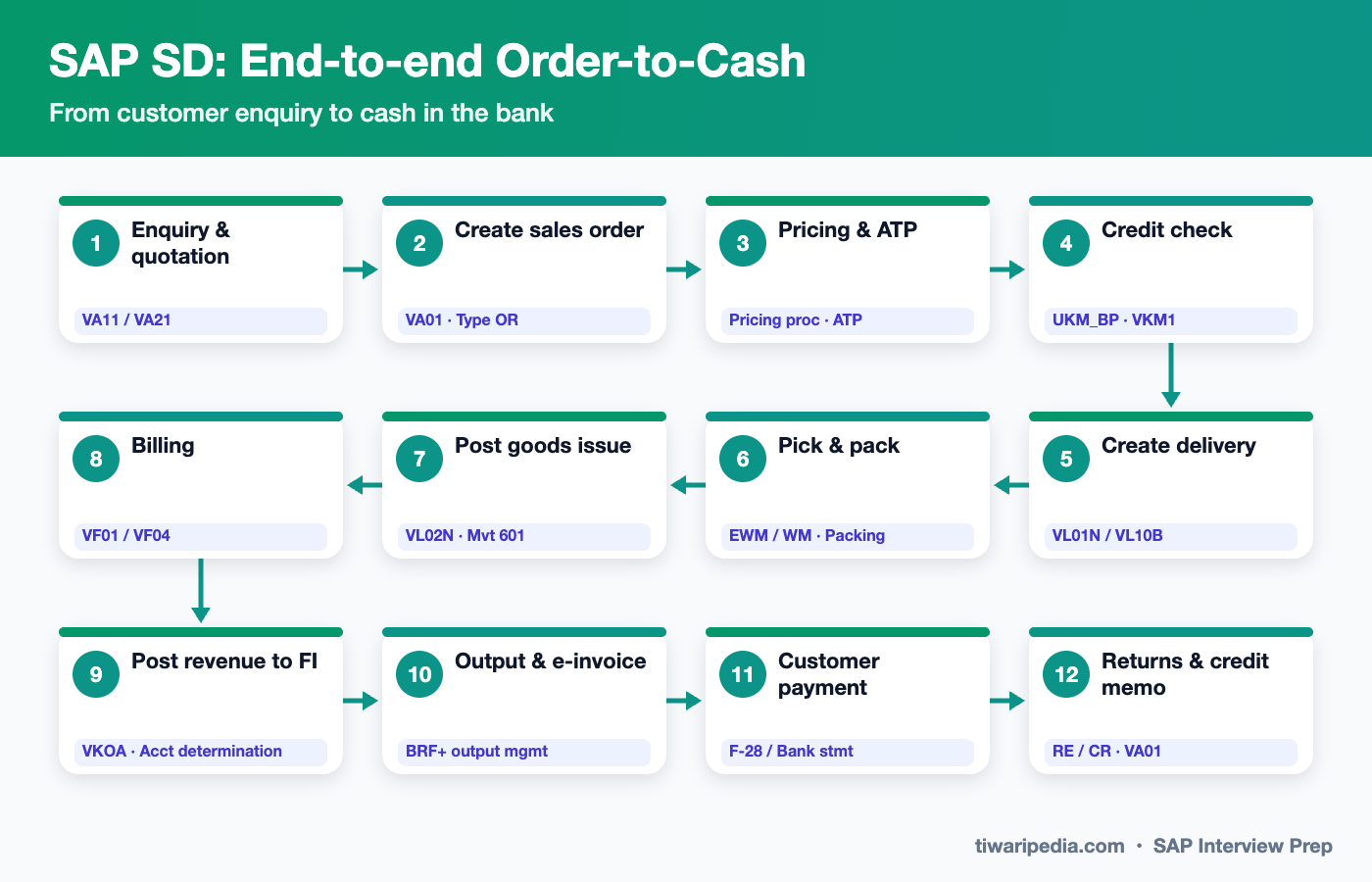
- Enquiry & quotation
VA11 / VA21
Pre-sales documents record customer interest and binding offers with validity dates. They are copied into the order. - Create sales order
VA01 · Type OR
The order captures sold-to and ship-to parties, materials, quantities and dates. Partner, item category and schedule line determination happen automatically. - Pricing & ATP
Pricing proc · ATP
The pricing procedure computes price, discounts, freight and tax through condition technique. ATP confirms quantity and delivery dates. - Credit check
UKM_BP · VKM1
SAP Credit Management checks exposure against the credit limit. Blocked orders go to a credit controller for release. - Create delivery
VL01N / VL10B
The outbound delivery is created from due orders by shipping point, with route and dates from delivery scheduling. - Pick & pack
EWM / WM · Packing
Warehouse tasks pick the goods, then the goods are packed into handling units. - Post goods issue
VL02N · Mvt 601
PGI reduces stock, posts cost of goods sold in FI and updates document flow. Ownership transfers to the customer. - Billing
VF01 / VF04
The invoice is created from the delivery (or from the order for services). Copy control and billing type decide what is copied. - Post revenue to FI
VKOA · Acct determination
Revenue, discount and tax accounts are determined automatically and the accounting document posts to the customer account. - Output & e-invoice
BRF+ output mgmt
Invoices are output via print, email, EDI or e-invoicing channels such as GST e-invoice in India. - Customer payment
F-28 / Bank stmt
The incoming payment clears open items in FI-AR. Dunning handles overdue invoices. - Returns & credit memo
RE / CR · VA01
Returns orders, return deliveries (mvt 651) and credit memos handle complaints, and the cycle feeds analytics.
Organizational structure & master data
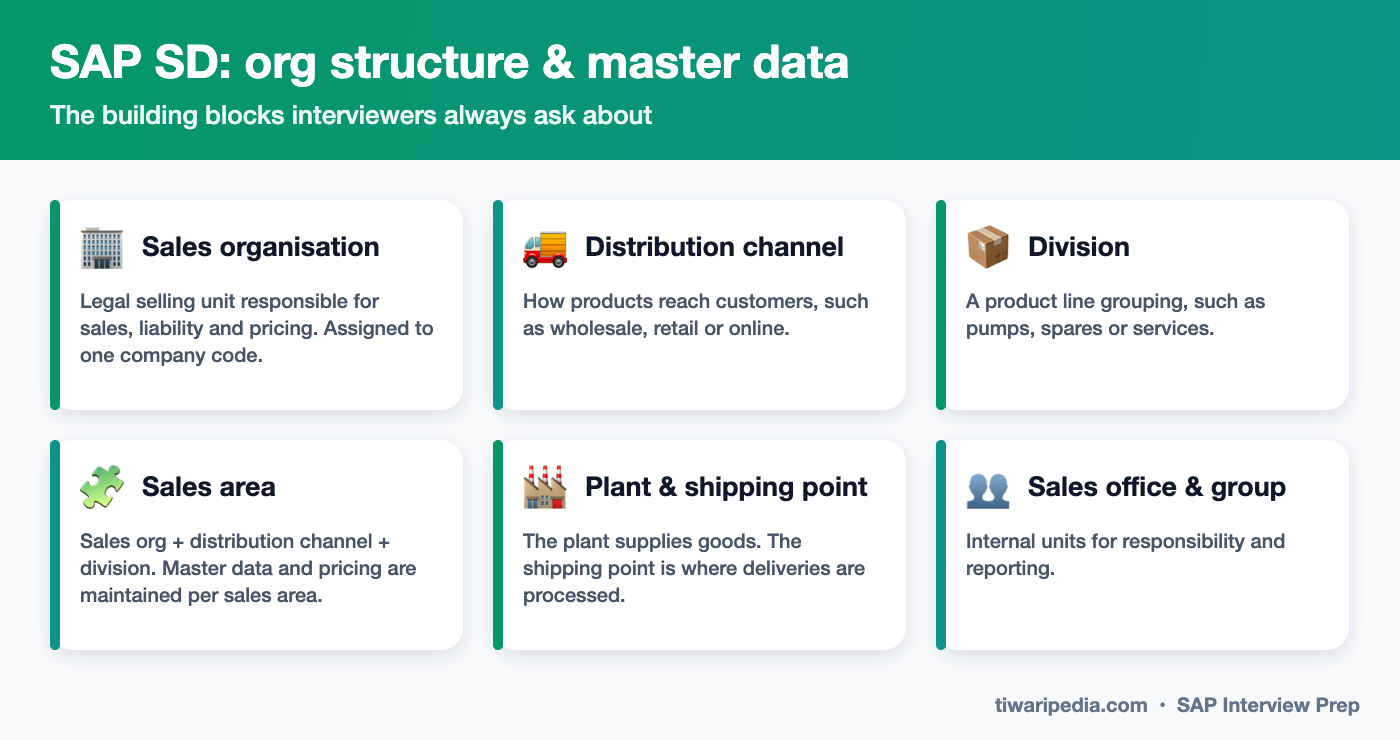
Organizational structure
Sales organisation
Assigned to exactly one company code. Many sales orgs can share one company code.
Distribution channel and division
Combined with the sales org to form a sales area, which is assigned to sales offices.
Plant assignment
Plants are assigned to sales org and distribution channel combinations to allow delivery from that plant.
Shipping point
Assigned to plants. Determined from shipping condition, loading group and plant.
Sales office and sales group
Optional units for sales responsibility.
Credit segment
In SAP Credit Management, credit limits are controlled per credit segment assigned to the credit control area.
Master data
Business Partner (BP)
In S/4HANA, customers are created through BP with roles (FLCU00 for FI, FLCU01 for sales). Partner functions: SP, SH, BP, PY.
Material master sales views
Sales org 1 and 2 and Sales: General/Plant, with item category group, delivering plant, loading group and tax classification.
Condition records (VK11)
Prices, discounts, surcharges and freight maintained per access sequence key combination.
Customer-material info record (VD51)
Maps the customer material number to your material number.
Credit master data
Credit limit, risk class and check rule per credit segment (UKM_BP).
Output condition records
Determine when and how documents like order confirmations and invoices are sent.
Key T-codes & Fiori apps
Interviewers often ask you to name the transaction or app for a step. You do not need to memorise hundreds, but you should know these confidently.
| T-code / App | What it does |
|---|---|
| VA01 / VA02 / VA03 | Create / change / display sales order |
| VA11 / VA21 | Create enquiry / quotation |
| VA41 | Create contract |
| VL01N / VL02N | Create / change outbound delivery (PGI) |
| VL10B | Delivery due list |
| VF01 / VF04 / VF11 | Create billing / billing due list / cancel billing |
| VK11 / VK12 | Create / change condition records |
| V/08 | Maintain pricing procedure |
| OVKK | Pricing procedure determination |
| VTAA / VTLA / VTFL | Copy control (order to order / delivery / billing) |
| VKOA | Revenue account determination |
| UKM_BP / UKM_CASE | Credit management master data / credit cases |
| BP | Maintain Business Partner (customer) |
| Fiori: Create Sales Orders, Manage Sales Orders, Sales Order Fulfillment Issues | Modern sales and fulfilment apps |
What changed in S/4HANA
- Business Partner is mandatory: customer master transactions (XD01, VD01) redirect to BP, with Customer-Vendor Integration (CVI).
- SAP Credit Management (FSCM) replaces classic SD credit management (FD32): credit segments, scoring and credit cases.
- Simplified data model: status tables VBUK and VBUP are removed (statuses move into VBAK, VBAP, LIKP and LIPS), and document flow VBFA is streamlined.
- Settlement Management with condition contracts replaces classic SD rebate agreements.
- Advanced ATP (aATP) brings product allocation, backorder processing and alternative-plant confirmation.
- Output Management with BRF+ is the default, alongside NAST-based output for compatibility.
- SD analytics move from LIS (VIS tables) to embedded analytics with CDS views and Fiori apps.
Integration points
| With | How it integrates |
|---|---|
| FI | PGI posts COGS. Billing posts revenue, tax and the customer receivable through VKOA account determination. Payments clear in FI-AR. |
| MM | Third-party orders create PRs to vendors. Stock availability, batches and consignment special stock. |
| PP | Make-to-order: sales order requirements drive MRP and production with sales order stock (E). |
| CO-PA | Billing values and costs flow into margin analysis by customer, product and region. |
| LE / EWM | Delivery, picking, packing, transport and goods issue processing. |
| PS | Customer projects link sales orders to billing WBS elements with billing plans. |
| Credit Management | Credit exposure from orders, deliveries and open invoices checked against limits. |
Interview questions & answers
Tap a question to see a model answer. They are grouped from fundamentals to scenario-based questions that senior panels love.
🟢 Fundamentals
Explain the Order-to-Cash cycle. Beginner
What is a sales area? Beginner
What is the condition technique? Beginner
How is the pricing procedure determined? Beginner
What is copy control? Beginner
How is the item category determined? Beginner
What happens at post goods issue? Beginner
🟡 Intermediate
Explain the third-party sales process. Intermediate
Explain the consignment process. Intermediate
How does revenue account determination work? Intermediate
What is the difference between the requirement and the alternative calculation type in pricing? Intermediate
What changed in credit management in S/4HANA? Intermediate
How does intercompany sales work? Intermediate
🔴 Scenario & design
A customer complains that a discount is not appearing on the order. How do you troubleshoot? Scenario
Orders are getting blocked for credit even for good customers. What would you check? Scenario
How would you design returns for damaged goods? Scenario
The business needs volume rebates. What do you propose in S/4HANA? Scenario
How would you implement GST e-invoicing for Indian sales? Scenario
How do you handle make-to-order sales? Scenario
What testing would you plan for an SD rollout to a new country? Scenario
Solution architect view
Key SD design decisions:
- Enterprise structure: the number of sales orgs (legal and pricing autonomy), distribution channels and divisions. Too many sales areas multiplies master data maintenance.
- Document types and item categories: keep a lean standard set and extend only for genuine process differences.
- Pricing strategy: pricing procedure design, condition tables by access level, and integration with SAP CPQ or a pricing engine if needed.
- Credit and risk: SAP Credit Management rules, credit segments and scoring.
- Fulfilment: aATP, EWM integration and transportation management.
- Compliance: e-invoicing (DRC), tax engines, and revenue accounting (IFRS 15) through RAR where needed.
- Front-office integration: SAP Sales Cloud / CX, e-commerce and EDI for order intake via Integration Suite.
Typical deliverables: O2C process design, pricing design workbook, output and form catalogue, interface specifications (EDI, CRM, tax), and data migration design for BP, conditions and open orders.
Test yourself: scored SD quiz
Interview tips
- Narrate O2C with documents, T-codes and FI postings at PGI and billing.
- Practise explaining condition technique with a real pricing procedure example.
- Know at least four special processes: third-party, consignment, intercompany, returns.
- Mention S/4HANA changes: BP, Credit Management, condition contracts, aATP, simplified tables.
- For architect roles, talk about how you reduced sales areas or document types to simplify the design.
Keep preparing: 🎯 SAP Interview Prep hub & combined mock test · All SAP interview guides · ERP Software




