

Last updated: October 2026 · 3 min read
Electric vehicles (EVs) are often seen as the future of transport, but their story goes back more than a century. Here are 10 incredible facts about EVs.
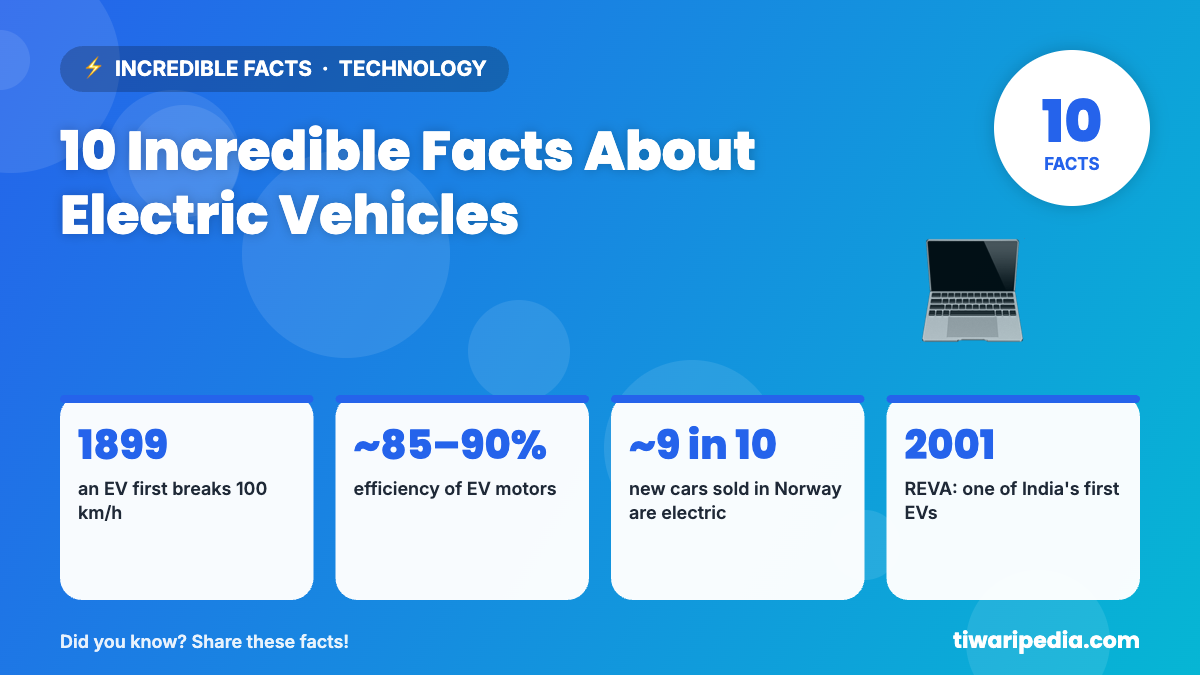
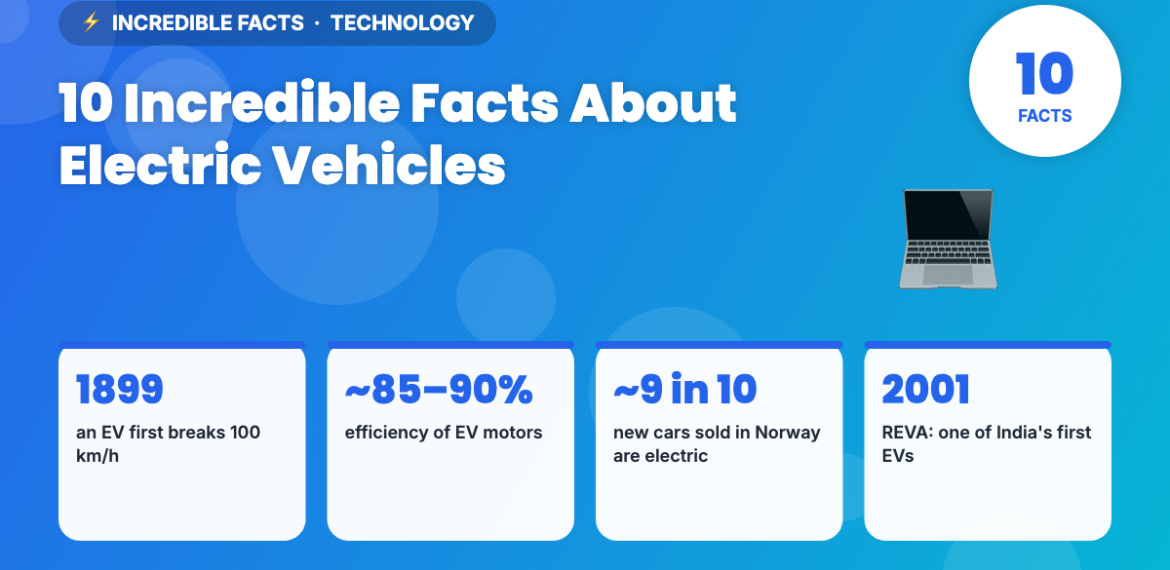
10 incredible facts about electric vehicles
1. Electric cars came before petrol cars took over
Electric cars were developed in the 19th century and were popular in some American cities around 1900, before cheap petrol and mass-produced cars took over.
2. An electric car broke 100 km/h in 1899
A Belgian electric car called “La Jamais Contente” became the first road vehicle to exceed 100 km/h in 1899.
3. EV motors are very efficient
Electric motors turn around 85–90% of their energy into motion, while petrol engines typically convert only about 20–30%, losing the rest as heat.
4. They recover energy when braking
Regenerative braking lets EVs turn some of the energy of slowing down back into electricity to recharge the battery.
5. They have far fewer moving parts
An EV drivetrain has far fewer moving parts than a petrol engine, so there are no oil changes, spark plugs or exhaust systems to maintain.
6. Battery prices have crashed
The cost of lithium-ion battery packs has fallen by around 90% since 2010, making EVs much more affordable.
7. Norway leads the world
In Norway, around nine out of every ten new cars sold are fully electric.
8. India’s EV journey began early
The REVA, launched in Bengaluru in 2001, was one of the first electric cars sold in India.
9. India’s EV revolution runs on two and three wheels
In India, electric two-wheelers and three-wheelers, including e-rickshaws, make up the largest share of EV sales.
10. Governments are pushing EVs
India has supported EV adoption through schemes such as FAME (launched in 2015) and the PM E-DRIVE scheme (2024).
Frequently asked questions
How long does it take to charge an EV?
From under an hour on a fast charger to several hours on a home charger, depending on the battery and charger.
Are EVs better for the environment?
Over their lifetime, EVs generally produce fewer emissions than petrol cars, especially as more electricity comes from renewable sources.
How long do EV batteries last?
Many EV batteries are designed to last for many years and are often covered by warranties of around eight years.
Keep exploring
- What is cloud computing?
- The Industrial Revolution
- More Technology explainers on Tiwaripedia
- Browse all incredible facts
Facts are based on widely accepted scientific, historical and official sources at the time of writing. Spotted something that needs updating? Let us know.




