

Last updated: October 2026 · 3 min read
Mohandas Karamchand Gandhi led India’s freedom struggle through non-violence and inspired civil rights movements across the world. Here are 12 incredible facts about the Father of the Nation.
12 incredible facts about Mahatma Gandhi
1. He was born in Porbandar
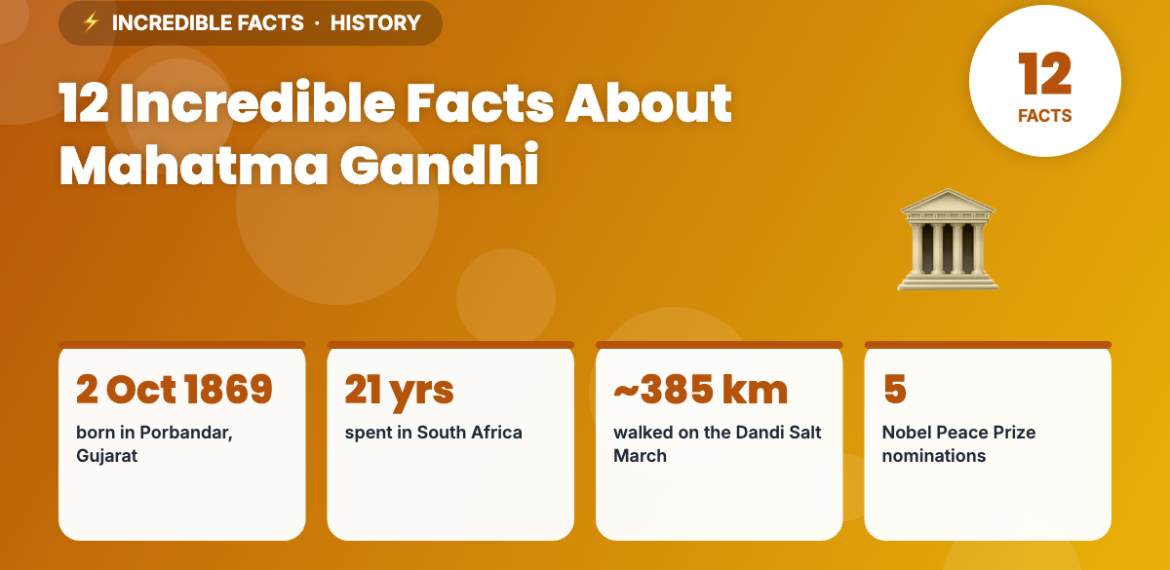
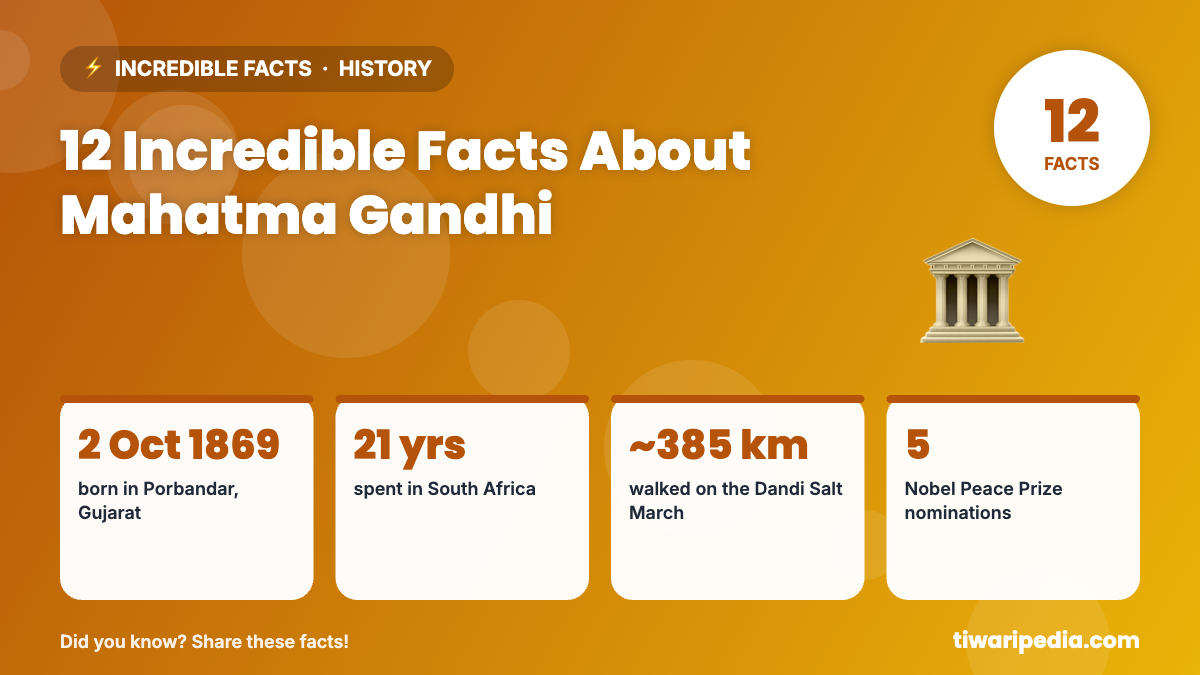
Gandhi was born on 2 October 1869 in Porbandar, Gujarat. His birthday is a national holiday in India and the UN’s International Day of Non-Violence.
2. He trained as a lawyer in London
Gandhi studied law in London and qualified as a barrister in 1891.
3. He spent 21 years in South Africa
From 1893 to 1914, Gandhi lived in South Africa, where he fought discrimination against Indians and developed his method of non-violent resistance, satyagraha.
4. A train journey changed his life
In 1893, he was thrown off a first-class train compartment at Pietermaritzburg because of his skin colour, an experience that strengthened his resolve to fight injustice.
5. He walked about 385 km for salt
In 1930, Gandhi led the Dandi March from Sabarmati Ashram to Dandi, about 385 km over 24 days, to make salt in defiance of the British salt tax.
6. He was never awarded the Nobel Peace Prize
Gandhi was nominated five times. The Nobel Committee later publicly acknowledged the omission.
7. TIME named him Man of the Year
TIME magazine named Gandhi its Man of the Year for 1930.
8. Others gave him his famous titles
The title “Mahatma” (great soul) is popularly linked to Rabindranath Tagore, and Subhas Chandra Bose called him “Father of the Nation” in a 1944 radio address.
9. He wrote his autobiography in Gujarati
“The Story of My Experiments with Truth” was first written in Gujarati and published in instalments in the 1920s.
10. The spinning wheel was his symbol
Gandhi promoted khadi and the charkha (spinning wheel) as symbols of self-reliance and boycott of foreign cloth.
11. He appears on Indian banknotes
Gandhi’s portrait has appeared on Reserve Bank of India banknotes since the Mahatma Gandhi Series began in 1996.
12. 30 January is Martyrs’ Day
Gandhi was assassinated on 30 January 1948 in New Delhi. India observes the day as Martyrs’ Day.
Frequently asked questions
What is satyagraha?
Gandhi’s philosophy of non-violent resistance, meaning “holding firmly to truth”.
Which movements did Gandhi lead in India?
Major ones include Champaran (1917), Non-Cooperation (1920–22), Civil Disobedience and the Salt March (1930), and Quit India (1942).
Where is Gandhi’s memorial?
Raj Ghat in New Delhi marks the spot where he was cremated.
Keep exploring
- India’s freedom struggle: key events from 1857 to 1947
- How India’s Constitution was made
- More History explainers on Tiwaripedia
- Browse all incredible facts
Facts are based on widely accepted scientific, historical and official sources at the time of writing. Spotted something that needs updating? Let us know.




