

Last updated: October 2026 · 3 min read
Every bit of light and warmth on Earth begins with one star: the Sun. Without it there would be no plants, no weather and no life. Here are 10 incredible facts about the star at the centre of our solar system.
10 incredible facts about the Sun
1. It holds almost all the mass
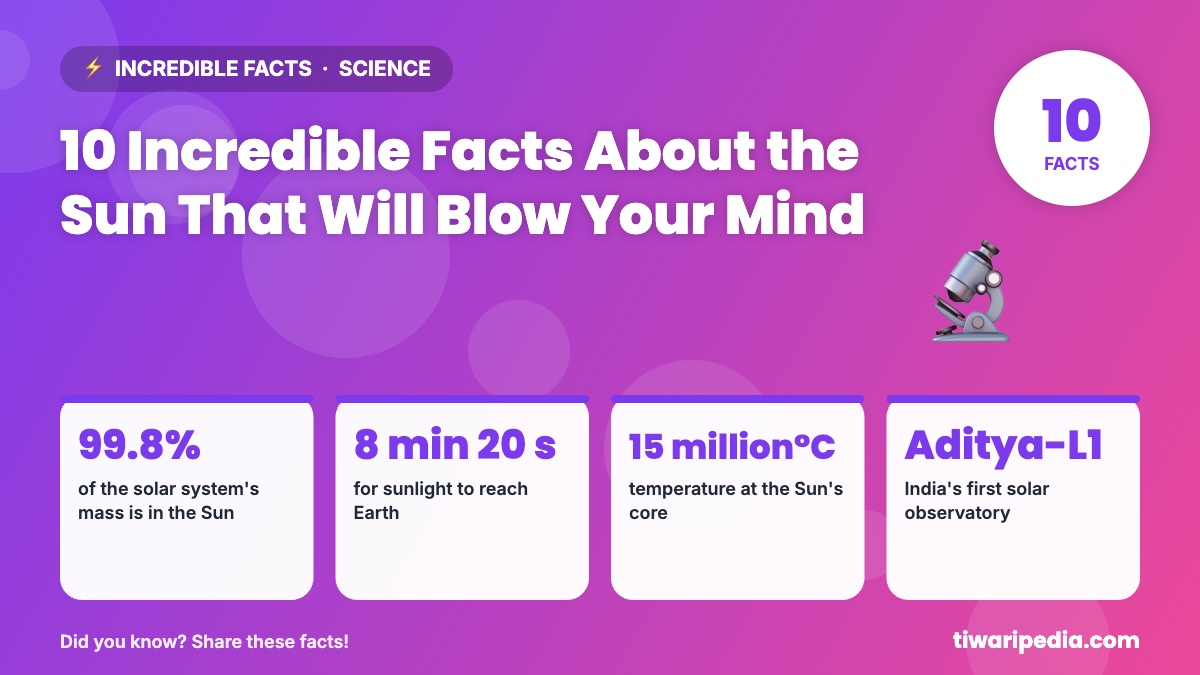
The Sun contains about 99.8% of all the mass in our solar system. All the planets, moons, asteroids and comets together make up the tiny remainder.
2. About 1.3 million Earths could fit inside
The Sun’s diameter is roughly 109 times that of Earth, so about 1.3 million Earths could fit inside it.
3. Sunlight is over 8 minutes old
Light travels from the Sun to Earth in about 8 minutes and 20 seconds. When you look at the Sun (never directly!), you see it as it was over eight minutes ago.
4. Its core is incredibly hot
The temperature at the Sun’s core is around 15 million °C, while its visible surface is about 5,500 °C.
5. Its atmosphere is hotter than its surface
Strangely, the Sun’s outer atmosphere, the corona, reaches over a million degrees Celsius, far hotter than the surface. Explaining why is one of the big puzzles in solar science.
6. It is about halfway through its life
The Sun formed about 4.6 billion years ago. Scientists expect it to keep shining steadily for roughly another 5 billion years before swelling into a red giant.
7. It is mostly hydrogen and helium
By mass, the Sun is about 73% hydrogen and 25% helium, with small amounts of heavier elements such as oxygen, carbon and iron.
8. It turns matter into energy
In its core, the Sun fuses hydrogen into helium. Every second, about 4 million tonnes of matter are converted into energy, as described by Einstein’s famous equation E = mc².
9. The Sun is actually white
The Sun emits all colours of visible light, which combine to make white. It looks yellow or orange from Earth because our atmosphere scatters blue light, especially near sunrise and sunset.
10. India has a solar observatory in space
ISRO’s Aditya-L1, launched in September 2023, reached its orbit around the Sun–Earth Lagrange point L1 in January 2024, about 1.5 million km from Earth, to study the Sun continuously.
Frequently asked questions
What type of star is the Sun?
The Sun is a yellow dwarf, technically a G-type main-sequence star.
How far is the Sun from Earth?
On average about 150 million km, a distance called one astronomical unit (AU).
Is it safe to look at the Sun?
No. Never look directly at the Sun, even during an eclipse, without certified solar viewing glasses. It can permanently damage your eyes.
Keep exploring
- Why is the sky blue?
- Black holes explained
- More Science explainers on Tiwaripedia
- Browse all incredible facts
Facts are based on widely accepted scientific, historical and official sources at the time of writing. Spotted something that needs updating? Let us know.




