

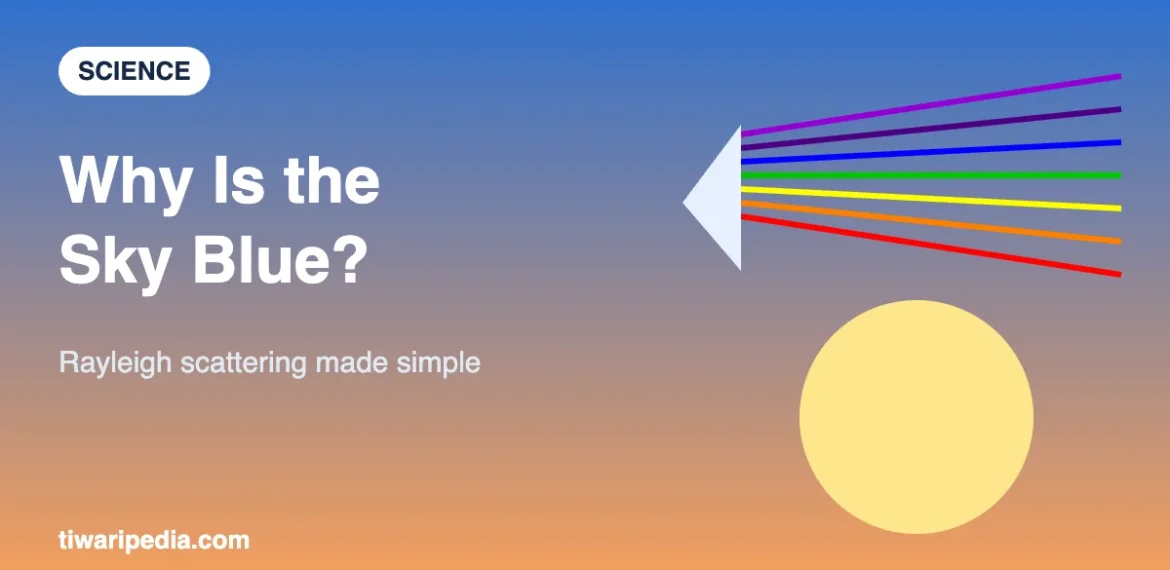
It is one of the oldest questions children ask, and one that puzzled scientists for centuries: why is the sky blue? The answer involves sunlight, tiny air molecules and a bit of physics called Rayleigh scattering. The same science also explains red sunsets, white clouds and why the sky on Mars looks butterscotch. Here is the full story, explained simply.
Key takeaways
- Sunlight contains all the colours of the rainbow mixed together.
- Air molecules scatter short wavelengths (blue and violet) far more strongly than long ones (red and orange). This is called Rayleigh scattering.
- The sky looks blue rather than violet because sunlight has less violet, some is absorbed high up, and our eyes are more sensitive to blue.
- At sunrise and sunset, light travels through much more air, so the blue is scattered away and reds and oranges remain.
Sunlight is a mix of colours
Sunlight looks white, but as Isaac Newton showed with a prism in the 1660s, it is really a mixture of colours: red, orange, yellow, green, blue, indigo and violet. Each colour is light of a different wavelength. Red light has long waves, around 700 nanometres (billionths of a metre), while blue and violet have short waves, around 400 to 450 nanometres.
What happens when sunlight hits the air
Earth’s atmosphere is mostly nitrogen and oxygen molecules. These molecules are much smaller than the wavelength of visible light. When sunlight passes through, the light makes the electrons in these molecules vibrate, and they re-emit light in all directions. This is called scattering.
Crucially, the amount of scattering depends strongly on wavelength. The British scientist Lord Rayleigh worked out in the 1870s that scattering by small particles is proportional to 1 divided by the wavelength to the fourth power. In plain terms, blue light is scattered about 5 to 6 times more than red light.
So as sunlight streams through the air, blue light gets bounced around the sky in every direction. Wherever you look, away from the Sun, some of this scattered blue light reaches your eyes. The whole sky glows blue.
Then why isn’t the sky violet?
Violet has an even shorter wavelength than blue, so it scatters even more. Three reasons explain why we see blue instead:
- Sunlight contains less violet than blue to begin with.
- Some violet is absorbed high in the atmosphere, partly by the ozone layer.
- Our eyes are less sensitive to violet. The colour-sensing cone cells in the human eye respond strongly to blue and much more weakly to violet. The mix of scattered colours that reaches us is interpreted by the brain as sky blue.
Why sunsets are red and orange
At midday the Sun is high, and its light takes a short path through the atmosphere. At sunrise and sunset, the Sun is low on the horizon, and its light has to cross a much longer stretch of air, up to about 40 times as much.
Along that long path, most of the blue light is scattered out sideways before it reaches you. What survives is mostly the longer wavelengths: yellow, orange and red. That is why the Sun and the clouds around it glow in warm colours at dusk. Dust, smoke and pollution particles can make sunsets even more vivid, which is why volcanic eruptions sometimes produce spectacular sunsets around the world.
Why clouds are white
Cloud droplets are much bigger than air molecules, about the same size as or larger than the wavelength of light. Large particles scatter all colours roughly equally, a process called Mie scattering. When all colours are scattered together, the result is white. Thick clouds look grey underneath simply because less light gets through them.
The sky on other worlds
| Place | Daytime sky | Why |
|---|---|---|
| Earth | Blue | Rayleigh scattering by nitrogen and oxygen |
| Moon | Black | No atmosphere, so nothing scatters light |
| Mars | Butterscotch by day, bluish at sunset | Fine reddish dust scatters light differently |
| Titan (Saturn’s moon) | Orange haze | Thick smog of organic molecules |
Astronauts on the Moon saw a pitch-black sky even in full sunshine, a vivid demonstration that the blue sky is entirely a gift of our atmosphere.
A quick experiment you can try
Fill a clear glass with water and add a few drops of milk. Shine a torch through the side in a dark room. Looking from the side, the water looks slightly bluish, because the tiny milk particles scatter blue light. Looking through the glass towards the torch, the light looks yellow-orange, like a sunset. You have made a sky in a glass.
Frequently asked questions
Is the sky blue because it reflects the ocean?
No, this is a common myth. The sky is blue even over deserts. If anything, it is the other way round: the ocean looks blue partly because it reflects the sky, and partly because water absorbs red light.
Why is the sky paler near the horizon?
Light from near the horizon passes through more air and is scattered many times, which mixes the colours and makes the sky look whiter.
Who first explained the blue sky?
John Tyndall studied light scattering in the 1850s and 1860s, and Lord Rayleigh gave the mathematical explanation in 1871. Albert Einstein later refined it in 1910.
Conclusion
The blue sky is sunlight being bounced around by countless tiny molecules, with blue scattered most of all. The same physics paints our sunsets red and our clouds white. Next time you look up, you are seeing the atmosphere itself glowing.
Keep reading on Tiwaripedia
- 12 Incredible Facts About the Universe That Will Make You Feel Tiny
- 10 Incredible Facts About the Moon: From Moonquakes to Chandrayaan-3
- 10 Incredible Facts About Trees, From Giant Redwoods to the Great Banyan
- 10 Incredible Facts About Water, the Molecule of Life
- How Do Vaccines Work? The Immune System, Vaccine Types and Herd Immunity Explained
- 10 Incredible Facts About the Sun That Will Blow Your Mind
More guides: All Science articles
