


☁️ What is Salesforce? A beginner’s guide
Salesforce is the world’s most widely used customer relationship management (CRM) platform. This guide explains what it does, how it works, its main products and why it creates so many jobs, in plain English.
If you have ever been called by a bank about a loan you enquired about, raised a complaint with an airline, or received a personalised offer from an online shop, there is a good chance Salesforce was working in the background. Salesforce is cloud software that helps companies find customers, sell to them, serve them and keep them happy, all from one shared system.
It is also one of the biggest technology career ecosystems in the world. Companies need administrators, developers, consultants and architects to set it up and run it. That is why so many students and working professionals in India want to learn it.
📝 Jump to the free Salesforce basics quiz
What is CRM?
CRM stands for Customer Relationship Management. It is a way of keeping everything a business knows about its customers in one place: who they are, what they bought, every call, email and complaint, and what they might need next.
Without a CRM, this information sits in spreadsheets, email inboxes and people’s heads. When a salesperson leaves, their customer knowledge leaves with them. A CRM fixes that by giving sales, service and marketing teams a single shared view of each customer.
Without a CRM
Scattered spreadsheets, missed follow-ups, no idea which deals will close, customers repeating their problem to every agent.
With a CRM
One record per customer, automatic reminders, a live sales pipeline, a complete case history and reports for managers.
What is Salesforce?
Salesforce, Inc. is an American software company founded in 1999 in San Francisco by Marc Benioff, Parker Harris, Dave Moellenhoff and Frank Domingues. It became famous for its “No Software” campaign, because it delivered CRM over the internet at a time when business software had to be installed on company servers.
Today Salesforce is much more than a sales tool. It is a family of cloud applications for sales, customer service, marketing, e-commerce, analytics and AI, all built on one platform. Industry analyst IDC has ranked Salesforce the No.1 CRM provider for more than a decade, and the company reported revenue of about US$41.5 billion for its 2026 financial year.
| Fact | Details |
|---|---|
| Type of software | Cloud-based CRM and business application platform (SaaS) |
| Founded | 1999, San Francisco, USA |
| Access | Web browser and the Salesforce mobile app; nothing to install |
| Upgrades | Three automatic releases a year: Spring, Summer and Winter |
| Learning platform | Trailhead (free) |
| App marketplace | AppExchange |
| AI layer | Agentforce (AI agents) and the Einstein Trust Layer |
How Salesforce works
Think of Salesforce as a building with several floors. Users work on the top floor through apps; everything underneath is shared.
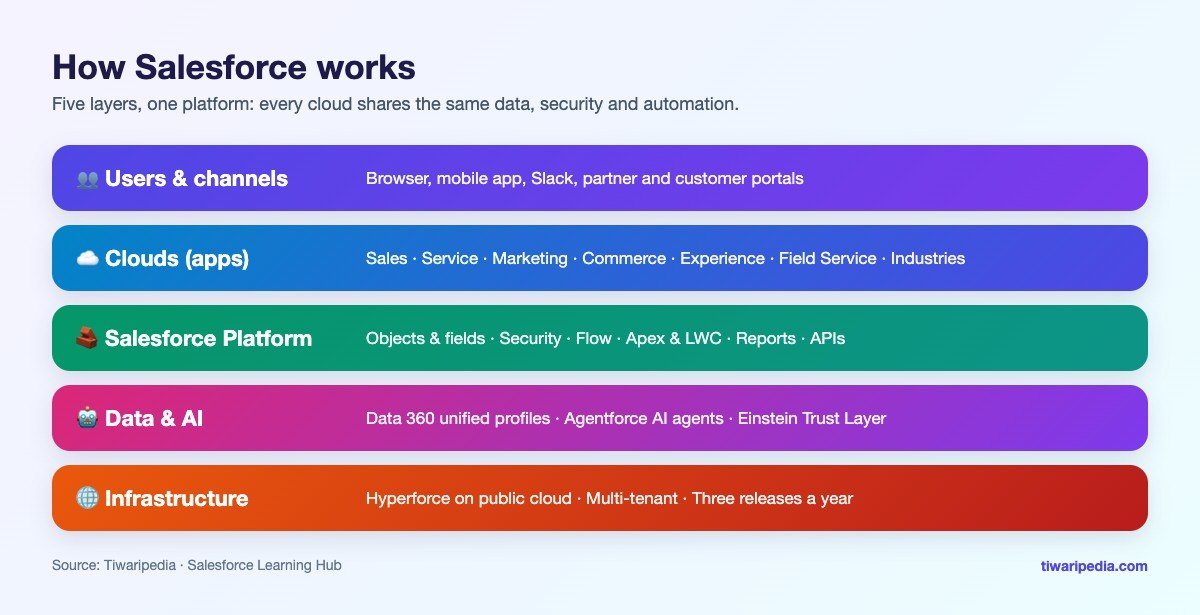
- Users and channels
Browser · Mobile · Slack
Salespeople, service agents, marketers, partners and customers use Salesforce through Lightning apps, the mobile app, portals and Slack. - Clouds (applications)
Sales · Service · Marketing
Ready-made applications for each business area, such as Sales Cloud and Service Cloud, sit on top of the platform. - Salesforce Platform
Objects · Flow · Apex
Shared building blocks: the database, security, automation (Flow), code (Apex and Lightning Web Components), reports and APIs. - Data and AI
Data 360 · Agentforce
Data 360 unifies customer data from many systems, and Agentforce AI agents use it to answer questions and complete tasks, protected by the Einstein Trust Layer. - Infrastructure
Hyperforce
Salesforce runs on public cloud infrastructure (Hyperforce), with data residency options in several countries, including India.
Two ideas make Salesforce different from older business software:
Multi-tenant
All customers share the same infrastructure and code, a bit like flats in one building. Each company’s data and settings (its org) are kept separate and secure.
Metadata-driven
When an admin adds a field or changes a page, Salesforce stores it as metadata (data about data). That is why you can customise a lot without code, and why upgrades don’t break your changes.
Declarative first
Most changes are made with point-and-click tools in Setup: fields, page layouts, validation rules and Flows. Code is used only when needed.
Always current
Salesforce upgrades everyone three times a year. There is no expensive upgrade project like with on-premise ERP.
Objects, fields and records: the building blocks
If you understand these three words, you understand how data is stored in Salesforce:
| Term | Meaning | Example |
|---|---|---|
| Object | A table that stores one type of information | Account (companies), Contact (people), Opportunity (deals), Case (complaints) |
| Field | A column on an object | Account Name, Phone, Industry, Annual Revenue |
| Record | One row of data | The account “Tata Steel” with all its field values |
| Relationship | A link between objects | A contact belongs to an account; an opportunity belongs to an account |
| Standard object | Comes with Salesforce | Lead, Account, Contact, Opportunity, Case, Campaign |
| Custom object | Created by your company; API name ends in __c | Property__c for a real-estate firm, Policy__c for an insurer |
On top of the data, Salesforce gives you page layouts and Lightning pages to display it, profiles and permission sets to control who can see it, Flows to automate it and reports and dashboards to analyse it.
Main Salesforce products (“clouds”)
Salesforce calls its main applications “clouds”. Most companies start with one or two and add more over time. We cover each in detail in our clouds guide.
| Product | What it is used for |
|---|---|
| Sales Cloud | Leads, accounts, opportunities, forecasting and the sales pipeline |
| Service Cloud | Customer support: cases, contact centre, knowledge and SLAs |
| Marketing Cloud | Email, SMS and WhatsApp campaigns, customer journeys and personalisation |
| Commerce Cloud | B2C and B2B online stores |
| Experience Cloud | Portals and websites for customers, partners and dealers |
| Data 360 | Unified real-time customer data (formerly called Data Cloud) |
| Agentforce | AI agents that answer questions and take actions |
| Field Service | Scheduling technicians and managing on-site work |
| Industry clouds | Ready-made solutions for banking, insurance, healthcare, manufacturing, automotive and more |
| Tableau, MuleSoft and Slack | Analytics, integration and collaboration products owned by Salesforce |
Editions and pricing model
Salesforce is sold as a subscription per user per month, usually billed annually. Each cloud comes in editions that unlock more features and higher limits as you go up.
| Edition | Typical customer |
|---|---|
| Starter / Pro Suite | Small businesses that want a simple, ready-to-use CRM |
| Enterprise | The most common edition for mid-size and large companies: full customisation, automation and APIs |
| Unlimited | Large enterprises that need more storage, sandboxes and premium support |
| Agentforce 1 / top tiers | Bundles that add AI, Data 360 and higher capacity |
Prices and edition names change regularly, so always check the official Salesforce pricing page. For learning, you never need to pay: a free Developer Edition org and Trailhead playgrounds give you a full working Salesforce environment.
Who uses Salesforce?
Salesforce reports more than 150,000 customers worldwide, from start-ups to the world’s largest companies. In India it is used heavily by banks, insurers, NBFCs, telecom operators, automobile companies, real estate developers, edtech firms and IT services companies.
Banking & insurance
Loan origination, customer onboarding, policy servicing and complaint management.
Automotive
Dealer management, test-drive bookings and after-sales service.
Real estate
Site-visit tracking, bookings, payment schedules and customer portals.
Education
Student enquiries, admissions, counselling and alumni engagement.
Why Salesforce is so popular
- Fast to start: no servers or installation; a basic CRM can be live in weeks.
- Highly customisable: objects, fields, automation and pages can be changed without code.
- One platform: sales, service, marketing and AI share the same customer data.
- Huge ecosystem: thousands of AppExchange apps, partners and a large community (the “Trailblazer” community).
- Always up to date: three automatic releases a year, including new AI features.
- Jobs: every Salesforce customer needs admins, developers and consultants, which creates steady demand for skills.
How to start learning Salesforce
- Create a free Trailhead account
trailhead.salesforce.com
Sign up and complete the beginner trails on CRM basics and the Salesforce Platform. - Get a free practice org
Developer Edition / Playground
Practise creating objects, fields, page layouts, reports and Flows yourself. - Pick a path
Admin · Developer · Consultant
Admins configure, developers code, consultants design solutions for business processes. - Earn a certification
Associate → Administrator
Certifications are the main proof of skill for recruiters. - Build a small project
Portfolio
For example, a student admission CRM or a service desk, and explain it in interviews.
Read our Career in Salesforce guide for roles, certifications and salaries, and the Salesforce clouds explained guide for each product in depth. Both are linked from the Salesforce Learning Hub.
Frequently asked questions
🟢 Common questions
Is Salesforce a CRM or an ERP? Beginner
Do I need coding to learn Salesforce? Beginner
Is Salesforce free? Beginner
Is Salesforce difficult to learn? Beginner
What is Agentforce? Beginner
Test yourself: Salesforce basics quiz
- Salesforce is a cloud CRM platform that keeps every customer interaction in one place.
- Data lives in objects, fields and records; most changes are made without code.
- Sales Cloud, Service Cloud, Marketing Cloud, Data 360 and Agentforce are the products you will hear about most.
- You can learn for free with Trailhead and a Developer Edition org.
Keep learning: ☁️ Salesforce Learning Hub & combined mock test · All Salesforce guides
Salesforce, Agentforce, Sales Cloud, Service Cloud, Data 360, Slack, Tableau, MuleSoft and Trailhead are trademarks of Salesforce, Inc. Tiwaripedia is an independent learning site and is not affiliated with or endorsed by Salesforce. Product names, exam details and salaries change; check the official Salesforce and Trailhead websites for the latest information. Last updated October 2026.
Keep reading on Tiwaripedia
- SAP EWM Warehouse Structure and Master Data Explained: Storage Types, Bins and Process Types
- SAP PP (Production Planning) Interview Questions and Plan-to-Produce Guide (S/4HANA)
- SAP ABAP Interview Questions and Answers 2026 (HANA, RAP, CDS)
- Salesforce Explained (2026): Top 10 Clouds, Agentforce AI and How It Works With ERP
- What Is SAP EWM? Extended Warehouse Management Explained Simply (2026 Guide)
- Salesforce Sales Cloud Interview Questions and Lead-to-Cash Process Guide (2026)
More guides: All ERP Software articles
