

📐 SAP PS (Project Systems) interview guide
From project structuring to period-end settlement: the full PS lifecycle with T-codes, design choices and the scenario questions senior panels ask.
SAP Project Systems (PS) plans, budgets, executes and controls projects of any size: capital investments, engineer-to-order manufacturing, construction, R&D and customer service projects. PS sits at the crossroads of Finance, Logistics and Sales, which is why PS consultants who understand integration are highly valued.
What is SAP PS?
PS gives you two complementary structures:
- Work Breakdown Structure (WBS): the hierarchical, cost-oriented view of the project. Costs, budgets and revenues are planned and collected on WBS elements.
- Networks and activities: the time- and resource-oriented view. They hold dates, dependencies, internal labour, external services and materials.
Common project types include internal investment (capex) projects settled to assets, overhead/cost projects settled to cost centres, and customer projects with billing plans, results analysis and revenue recognition.
End-to-end process: Project lifecycle (structure to settlement)
Interviewers usually ask you to explain the PS lifecycle end to end, then dig into budgeting and settlement. Follow this sequence.
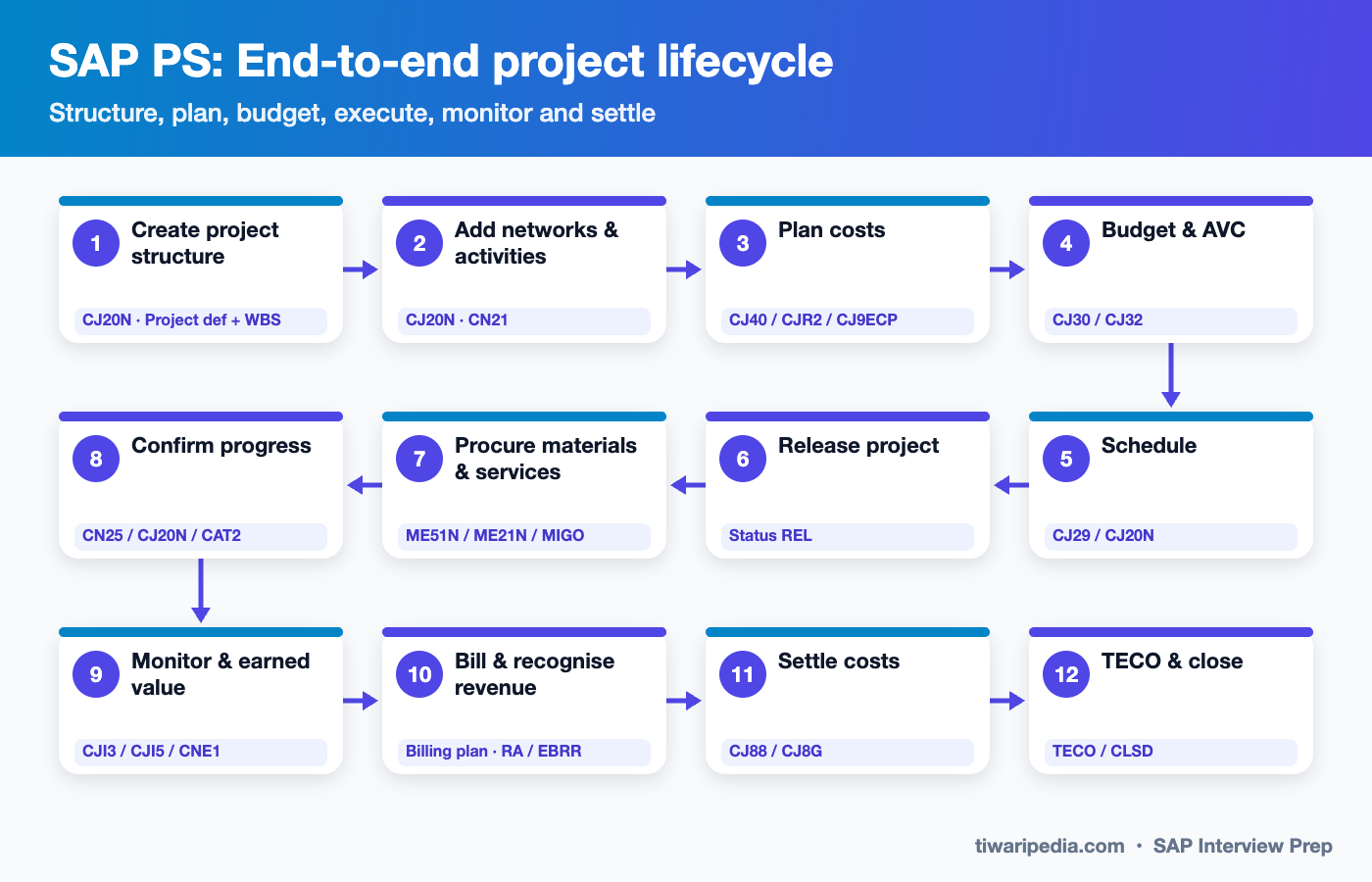
- Create project structure
CJ20N · Project def + WBS
Create the project definition from a project profile, then build the WBS hierarchy with planning, account assignment and billing indicators. Templates (CJ91) speed this up. - Add networks & activities
CJ20N · CN21
Add networks with internal, external, general-cost and service activities, relationships (FS, SS, FF, SF) and material components. - Plan costs
CJ40 / CJR2 / CJ9ECP
Plan costs structure-oriented on WBS, by cost element, through Easy Cost Planning, or automatically from network activities. - Budget & AVC
CJ30 / CJ32
Allocate the original budget, release it, and activate availability control so overspending triggers a warning or error. - Schedule
CJ29 / CJ20N
Forward or backward scheduling calculates earliest and latest dates and float. Milestones mark key events. - Release project
Status REL
Release allows actual postings, purchase requisitions and reservations. System statuses and user statuses control business transactions. - Procure materials & services
ME51N / ME21N / MIGO
External activities and non-stock components create PRs automatically. Stock items create reservations. Project stock (Q) can be used. - Confirm progress
CN25 / CJ20N / CAT2
Teams confirm hours and percentage complete on activities. Labour cost posts through the activity type rate. - Monitor & earned value
CJI3 / CJI5 / CNE1
Track actuals, commitments, plan vs actual and earned value (BCWS, BCWP, ACWP) through the information system and progress analysis. - Bill & recognise revenue
Billing plan · RA / EBRR
For customer projects, milestone billing runs via SD. Results analysis (KKA2) or event-based revenue recognition in S/4HANA calculates WIP and POC. - Settle costs
CJ88 / CJ8G
Period-end settlement moves costs to receivers: an asset under construction, the final asset, a cost centre or profitability analysis. - TECO & close
TECO / CLSD
Technically complete the project, run final settlement and capitalisation, then close it to block further postings.
Organizational structure & master data
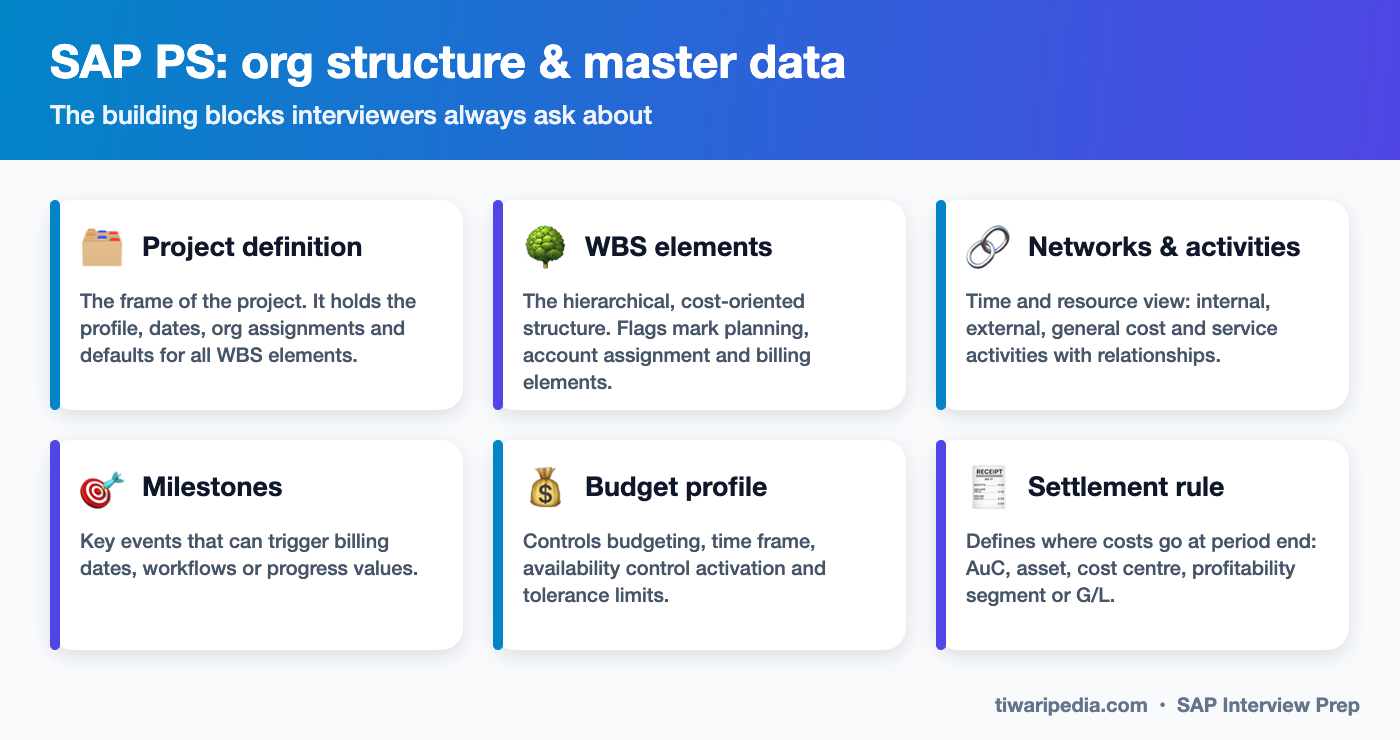
Organizational structure
Controlling area & company code
Every project is assigned to a controlling area and company code. A single project can span company codes when cross-company postings are allowed.
Profit centre, business area, plant
Defaulted from the project definition to the WBS elements and networks for reporting and logistics.
Project profile (OPSA)
The central control key with the planning, budgeting, scheduling, settlement and results analysis profiles.
Network profile & network type
Control network defaults, scheduling, costing variants and the number range.
Person responsible & applicant
Used for responsibility, workflow and reporting.
Investment Management link
Investment programs connect capex budgets across many projects for portfolio-level control.
Master data
Project definition & WBS (CJ20N)
Structure with operative indicators: planning element, account assignment element, billing element.
Standard structures
- Standard WBS (CJ91)
- Standard network (CN01)
- Copy from template or existing project
Network activities
- Internal processing (work centre and activity type)
- External processing (PR to vendor)
- General costs and service activities
Material components
BOM transfer (CN33) or manual assignment. Can be procured to project stock or plant stock.
Work centres & activity types
Capacity, scheduling and costing of internal labour via the activity rate (KP26).
Milestones & documents
Billing plans, trend analysis, PS texts and DMS documents.
Key T-codes & Fiori apps
Interviewers often ask you to name the transaction or app for a step. You do not need to memorise hundreds, but you should know these confidently.
| T-code / App | What it does |
|---|---|
| CJ20N | Project Builder: create and maintain project, WBS and network |
| CJ01 / CJ02 / CJ03 | Create / change / display WBS element (classic) |
| CN21 / CN22 | Create / change network |
| CJ40 / CJR2 | Overall cost planning / cost element planning |
| CJ9ECP | Easy Cost Planning |
| CJ30 / CJ32 / CJ34 | Original budget / release / budget transfer |
| CN25 / CN41N | Activity confirmation / project structure overview |
| CJI3 / CJI5 | Actual cost line items / commitment line items |
| S_ALR_87013558 | Budget / actual / commitment / remaining plan report |
| CNE1 / CNE5 | Progress analysis calculation / report |
| KKA2 / KKAJ | Results analysis individual / collective |
| CJ88 / CJ8G | Individual / collective settlement |
| CJ91 / CN01 | Standard WBS / standard network templates |
| Fiori: Monitor Projects, Project Cost Report, Project Control | Modern project monitoring and control apps |
What changed in S/4HANA
- The Universal Journal (ACDOCA) stores project actuals in real time with WBS as an account assignment dimension. No separate CO totals tables are needed for reporting.
- Event-based revenue recognition (EBRR) can replace period-end results analysis for customer projects, posting revenue and cost of sales as each event happens.
- Simplifications: some legacy functions (such as Claim Management and the old planning board variants) are deprecated or not the target. Check the Simplification List for your release.
- S/4HANA Cloud Public Edition uses Enterprise Projects and Commercial Project Management apps (Plan Customer Projects, Project Control), while classic PS remains strong in private cloud and on-premise.
- Fiori apps like Monitor Projects, Project Cost Report and Project Brief give live analytics on top of CDS views.
- Business Partner, 40-character material numbers and the new asset accounting affect project settlement and procurement.
Integration points
| With | How it integrates |
|---|---|
| FI / CO | WBS elements are cost objects. Actuals, commitments, overheads (costing sheet) and settlement all flow through CO into the Universal Journal. |
| FI-AA | Capex projects settle to an asset under construction, then to final assets at completion (line item settlement). |
| MM | PRs and POs for external activities and materials, reservations for stock, project stock (special stock Q). |
| SD | Customer projects: sales order linked to a billing WBS, billing plans (milestone or periodic), resource-related billing (DP90). |
| PP | Assembly processing and engineer-to-order: production orders against project stock and WBS-driven MRP. |
| HCM / CATS | Timesheets transferred to network confirmations or as activity allocations to WBS. |
| IM | Investment programs control capex budget distribution across projects. |
Business process flow: how PS connects to the rest of SAP
Senior interviews always test integration. This flow shows where each module touches a project, from sales to profitability.
100 SAP PS interview questions for 10+ years experience
Senior panels for PS lead, architect and manager roles go beyond definitions. These 100 questions move from configuration depth to real scenarios. Tap any question to see a model answer.
🏗️ Project structure & configuration
1. How do you decide the number of WBS levels for a global capex programme? Advanced
2. What is the purpose of a coding mask and what pitfalls have you seen? Advanced
3. Explain the project profile, network profile and network type and how they interact. Expert
4. When would you use an assembly order instead of a manually created project? Advanced
5. What are standard project structures (CJ91/CN01) and how do you govern them? Advanced
6. How do you design user status profiles in PS for an approval workflow? Expert
7. What is the difference between the system statuses CRTD, REL, TECO and CLSD in terms of allowed transactions? Advanced
8. How do you handle cross-company projects? Advanced
9. Why are WBS element field selections and validations/substitutions important? Expert
10. How do you integrate PS with Investment Management (IM)? Advanced
11. What is Project Builder (CJ20N) vs Project Planning Board (CJ2B)? Advanced
12. How do you model a project with multiple plants and work centres? Expert
13. What controls automatic PR creation from networks? Advanced
14. How do you use project versions (simulation vs project versions)? Advanced
15. What is the role of the person responsible and applicant fields, and how have you used them? Expert
💰 Planning, budgeting & availability control
16. Compare structure planning, detailed cost-element planning, Easy Cost Planning and network costing. Advanced
17. How do you set up AVC tolerance limits and why does CJBN matter? Expert
18. What is the difference between original budget, supplement, return and transfer? Advanced
19. How do you control budget release in stages? Expert
20. What are commitments in PS and how do they affect AVC? Advanced
21. How do you handle annual vs overall budget with multi-year projects? Expert
22. How do plan versions support forecast and baseline? Advanced
23. What is cost forecasting (CJ9L/CJ9M) and how is it used for EAC? Expert
24. How does overhead calculation apply to projects? Advanced
25. Explain interest calculation on projects. Expert
26. What causes budget to show as ‘distributable’ or ‘distributed’ incorrectly, and how do you fix it? Advanced
27. How do you upload large volumes of plans or budgets? Advanced
28. How does SAP Analytics Cloud project planning integrate with S/4HANA PS? Expert
29. What is the difference between cost planning and revenue planning on a billing element? Advanced
30. How do you prevent users bypassing AVC by posting to unbudgeted WBS? Expert
⚙️ Execution, procurement & logistics integration
31. How does project stock (valuated vs non-valuated) differ, and when do you choose each? Advanced
32. Explain material component procurement options in networks. Advanced
33. How do you run MRP for project-specific requirements? Expert
34. What is grouping, pegging and distribution (GPD)? Advanced
35. How do you capture labour time on projects? Advanced
36. What happens if confirmations are posted against an activity without a valid activity type rate? Expert
37. How do service activities and external services integrate with MM? Advanced
38. How is PS integrated with PM for maintenance-driven projects? Advanced
39. Explain earned value analysis parameters you configured. Expert
40. How do milestones drive business logic in PS? Advanced
41. What are the scheduling types and what is float? Advanced
42. How do you manage capacity levelling for engineering resources? Expert
43. How does Document Management (DMS) link to projects? Advanced
44. What is a claim in PS? Advanced
45. How do you handle change orders on a running customer project? Expert
📊 Period-end, results analysis & settlement
46. Describe the correct period-end sequence for a PS customer project. Expert
47. Results analysis methods: which have you used and why? Expert
48. What is event-based revenue recognition (EBRR) in S/4HANA? Expert
49. What is a settlement profile and what does it control? Advanced
50. Explain the allocation structure and source structure. Advanced
51. How does AuC settlement work for capex projects? Expert
52. What causes ‘settlement rule missing’ errors and how do you avoid them in mass? Advanced
53. What is the difference between periodic, full and final settlement? Advanced
54. How do you handle settlement reversals and corrections at year-end? Expert
55. How are WIP and reserves for unrealised costs posted to FI? Advanced
56. What reconciliation checks do you run after month-end close for projects? Expert
57. How do you settle to profitability analysis (CO-PA) with characteristics? Advanced
58. In S/4HANA, how did the Universal Journal change PS reporting? Expert
59. How do you handle overhead under/over absorption on projects? Advanced
60. What is margin analysis for projects in S/4HANA and how does it relate to EBRR? Expert
⚡ Quick-fire expert checks
61. Which transaction mass-changes WBS or network fields? Advanced
62. Which reports show project line items for actuals, commitments and plan? Advanced
63. How do you copy an operative project as a template? Advanced
64. What does CN41N show? Advanced
65. What does CJ8G do? Advanced
66. How are statuses set in mass? Advanced
67. What is the difference between CJ02 and CJ20N? Advanced
68. How do you transfer budget across fiscal years? Advanced
69. What is the purpose of OPSB? Advanced
70. Which transaction defines results analysis keys and versions? Advanced
🧾 Customer projects, billing & S/4HANA
71. How do you link a sales order to a project and what are the options? Advanced
72. Milestone billing vs periodic billing vs resource-related billing (RRB)? Advanced
73. What is a DIP profile and how do you design one? Expert
74. How do you handle down payments on projects? Advanced
75. What is SAP Commercial Project Management (CPM) and when is it used? Expert
76. What changed for PS in S/4HANA compared with ECC? Expert
77. What are Enterprise Projects in S/4HANA Cloud? Advanced
78. How do you migrate open projects from ECC to S/4HANA? Expert
79. Which Fiori apps do PS users rely on? Advanced
80. How do you use the S/4HANA Clean Core principle in a PS implementation? Expert
🧭 Scenario, architecture & leadership (10+ years)
81. A CFO says project margins differ between PS reports and CO-PA. How do you investigate? Scenario
82. Budget overruns are happening despite AVC. What could be wrong? Scenario
83. Settlement fails for 300 WBS elements at month-end. How do you recover quickly? Scenario
84. A client wants to move from RA to EBRR during S/4HANA migration. What is your approach? Scenario
85. Engineering wants a 7-level WBS, finance wants 3. How do you resolve it? Scenario
86. Primavera or MS Project is the scheduling master. How do you integrate with SAP PS? Scenario
87. How do you design PS for an EPC contractor with fixed-price contracts? Scenario
88. An auditor questions capitalised costs on a project. What evidence do you provide? Scenario
89. Users complain CJ20N is slow for big projects. What do you check? Scenario
90. How do you approach archiving projects? Scenario
91. How do you estimate effort for a PS implementation? Scenario
92. How do you run a fit-to-standard workshop for PS? Scenario
93. A project shows actual costs but no plan; management wants variance reporting. What do you do? Scenario
94. How would you integrate PS with SAP SuccessFactors or HR for resource costs? Scenario
95. How do you design security roles for PS? Scenario
96. What KPIs do you present to project steering committees? Scenario
97. Describe a production issue you solved in PS. Scenario
98. How do you mentor junior PS consultants on a project? Scenario
99. What is your approach to cut-over for PS? Scenario
100. Where do you see PS heading with AI and SAP’s roadmap? Scenario
Solution architect view
Key PS design decisions:
- Structure standards: how many WBS levels, what each level means, coding masks (OPSJ) and templates, so reporting is consistent across projects.
- Project types and profiles: separate profiles for capex, opex, customer and R&D projects, each with its own planning, budget, settlement and results analysis profiles.
- Planning approach: Easy Cost Planning vs network costing, and plan versions for baseline and forecast.
- Budget control: budget levels, release strategy and AVC tolerances aligned with the approval matrix.
- Revenue recognition: results analysis vs event-based revenue recognition for customer projects, agreed with Finance and auditors.
- Integration: SD billing plans, MM project stock, PP for engineer-to-order, CATS and Asset Accounting.
- Reporting: embedded analytics, Fiori project apps, and EVM KPIs (CPI, SPI).
Typical deliverables: PS design document with structure standards, profile matrix, period-end runbook (overheads, results analysis, settlement), and integration specs for SD, MM and FI-AA.
Test yourself: 20-question scored PS mock test
Interview tips
- Draw the WBS for a real project you worked on: levels, indicators and settlement receivers.
- Explain the difference between plan, budget, actuals and commitments with numbers.
- Be ready for period-end: overheads, interest, results analysis or EBRR, settlement, in that order.
- For customer projects, link SD billing plans, milestones and revenue recognition clearly.
- Mention S/4HANA items: Universal Journal, EBRR and Fiori project apps.
Keep preparing: 🎯 SAP Interview Prep hub & combined mock test · All SAP interview guides · ERP Software
Keep reading on Tiwaripedia
- SAP SD (Sales & Distribution) Interview Questions & Order-to-Cash Process Guide (S/4HANA)
- Oracle Fusion Cloud ERP Explained (2026): Top 10 Modules, AI Agents and Market Updates
- SAP EWM vs SAP WM vs Stock Room Management: Differences and Migration Guide (2026)
- What Is SAP EWM? Extended Warehouse Management Explained Simply (2026 Guide)
- SAP MM (Materials Management) Interview Questions & Procure-to-Pay Process Guide (S/4HANA)
- Embedded vs Decentralized SAP EWM: Differences, Licensing and How to Choose (2026)
More guides: All ERP Software articles

[…] upgradeable. It is the natural next step for experienced functional consultants in modules such as PS, SD, MM, EAM, Service and […]