

💼 Salesforce Sales Cloud interview guide
Lead-to-cash from first enquiry to won deal: lead management, opportunities, products and quotes, forecasting, territories and AI, with model answers and a scored test.
Sales Cloud is the original Salesforce product and still the one most companies start with. A Sales Cloud consultant designs how a company captures leads, manages its pipeline, prices and quotes, and forecasts revenue. Interviews test the lead-to-cash process, the standard objects and the right configuration choice for each requirement.
📝 Jump to the scored Sales Cloud test
End-to-end process: lead-to-cash
“Walk me through the sales process in Salesforce” is the classic opening question. Mention the object and the feature at each step.
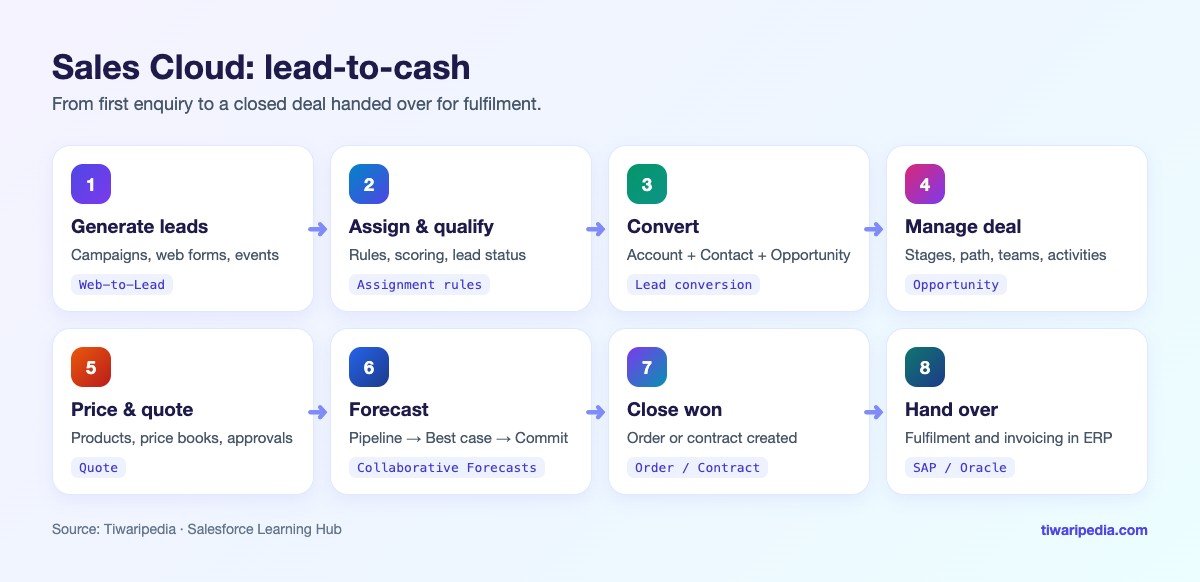
- Generate demand
Campaigns · Web-to-Lead
Marketing campaigns, web forms, events and partners create leads, with the campaign recorded as the source. - Assign and qualify
Assignment rules · Lead scoring
Assignment rules route leads to reps or queues; reps qualify them using criteria such as budget, authority, need and timeline. - Convert
Lead conversion
A qualified lead converts into an account, contact and opportunity, with duplicate checks. - Manage the opportunity
Stages · Path · Opportunity teams
The opportunity moves through stages with guidance on the path, activities and team collaboration. - Price and quote
Products · Price books · Quotes
Add products from the right price book, apply discounts with approvals and send a quote PDF. - Forecast
Collaborative Forecasts
Opportunities roll up into forecasts by category (Pipeline, Best Case, Commit, Closed). - Close and hand over
Closed Won · Order · Contract
The won deal creates an order or contract, often sent to ERP (such as SAP) for fulfilment and invoicing.
Key Sales Cloud objects
| Object | Purpose |
|---|---|
| Lead | An unqualified prospect or enquiry |
| Account | A company (B2B) or person (Person Account for B2C) |
| Contact | An individual linked to an account |
| Opportunity | A potential deal with stage, amount and close date |
| Product / Price Book / Price Book Entry | What you sell and at what price |
| Quote / Quote Line Item | A formal offer generated from an opportunity |
| Campaign / Campaign Member | Marketing activities and the leads or contacts they reach |
| Order / Contract | The commitment after the deal is won |
| Forecast items | Roll-ups used by Collaborative Forecasts |
Lead management
Capture
Web-to-Lead, imports, campaigns, partner portals and integrations from marketing tools.
Assign
Lead assignment rules to users or queues, round-robin through Flow or Omni-Channel.
Qualify
Lead status values, scoring and a lead process for each record type.
Convert
Field mapping from lead to account, contact and opportunity; duplicate rules prevent copies.
Opportunity management
- Sales processes control which stages each opportunity record type can use; each stage maps to a probability and forecast category.
- Path shows key fields and guidance for each stage.
- Opportunity teams and splits share deals and credit between team members.
- Validation rules enforce required information before stage changes.
- Activities (tasks, events, emails) and Einstein Activity Capture record engagement.
Products, price books and quotes
Every product has an entry in the standard price book; custom price books hold prices for specific markets, channels or currencies. Opportunities use one price book. Quotes are created from opportunities, can sync their line items back, use templates to generate PDFs and can be emailed to customers. For complex bundles, discount rules, subscriptions and billing, companies use Revenue Cloud (which includes the former Salesforce CPQ).
Forecasting and territories
| Feature | What it does |
|---|---|
| Collaborative Forecasts | Rolls up opportunity amounts or quantities by forecast category, period and the forecast hierarchy, with manager adjustments |
| Forecast types | By opportunity revenue, product family, splits or custom measures |
| Enterprise Territory Management | Assigns accounts to territories with rules, independent of the role hierarchy, and supports territory-based forecasts |
| Pipeline inspection | Shows pipeline changes, deal risk and next steps for managers |
AI in Sales Cloud
- Lead and opportunity scoring highlights the most promising records.
- Sales development agents built with Agentforce can follow up inbound leads and book meetings.
- Generative AI drafts emails, summarises accounts and prepares meeting briefs.
- Sales coaching and call insights analyse conversations for next steps.
Integration points
| System | Typical integration |
|---|---|
| Marketing Cloud / Account Engagement | Campaigns, lead scoring and nurturing |
| ERP (SAP, Oracle) | Customer master, products, prices, orders, credit limits and invoices |
| Service Cloud | Shared accounts, contacts and assets |
| Email and calendar | Outlook and Gmail integration, activity capture |
| Slack | Deal rooms and alerts |
Interview questions and answers
Tap a question to see a model answer.
🟢 Fundamentals
Explain the lead-to-cash process in Salesforce. Beginner
What happens when you convert a lead? Beginner
What is a price book? Beginner
What is a sales process? Beginner
What is Web-to-Lead? Beginner
🟡 Intermediate
How does Collaborative Forecasting work? Intermediate
Opportunity teams vs account teams? Intermediate
How do quotes sync with opportunities? Intermediate
How would you assign leads by region and product interest? Intermediate
What is Enterprise Territory Management? Intermediate
🔴 Scenario & design
Sales managers say the forecast is unreliable. What would you check? Advanced
A company sells in India and the Middle East in different currencies. How do you design pricing? Advanced
Discounts above 15% need approval. Design it. Advanced
How would you integrate Sales Cloud with SAP? Advanced
How would you use Agentforce in a sales team? Advanced
Solution architect view
Key Sales Cloud design decisions:
- Account model: business accounts, person accounts or both; account hierarchies for groups of companies.
- Sales processes: record types per business line, stage design and exit criteria.
- Access: role hierarchy vs territories, team selling and sharing for partners.
- Pricing: standard price books vs Revenue Cloud for configure-price-quote.
- Data: duplicate management, data enrichment and integration with ERP as the system of record for orders.
- AI: scoring and agents only after data quality is under control.
Test yourself: Sales Cloud test
Interview tips
- Narrate lead-to-cash with the object and feature at each step.
- Explain why you would choose territories over roles, or Revenue Cloud over standard quotes.
- Mention data quality: stage rules, close-date hygiene and duplicates.
- Show business impact: shorter sales cycles, better forecast accuracy, higher conversion.
Keep learning: ☁️ Salesforce Learning Hub & combined mock test · All Salesforce guides
Salesforce, Agentforce, Sales Cloud, Service Cloud, Data 360, Slack, Tableau, MuleSoft and Trailhead are trademarks of Salesforce, Inc. Tiwaripedia is an independent learning site and is not affiliated with or endorsed by Salesforce. Product names, exam details and salaries change; check the official Salesforce and Trailhead websites for the latest information. Last updated October 2026.
Keep reading on Tiwaripedia
- Salesforce Service Cloud Interview Questions and Case Management Guide (2026)
- Salesforce Clouds and Modules Explained: Sales, Service, Marketing, Data 360, Agentforce and More (2026)
- Salesforce Admin Interview Questions and Answers (2026): Security Model, Flow, Data and Reports
- Agentforce and Data 360 Interview Questions (2026): AI Agents, Prompt Builder, RAG and Trust Layer
- SAP Solution Architect Guide: SAP Activate, Implementation, Rollout, Support & Upgrade Projects Explained
- SAP PP, PP-PI, PP/DS & IBP Niche Skills: Junior, Senior, Solution Architect & Third-Party Integration (2026)
More guides: All ERP Software articles
