Quick answer: Newspapers make most of their money from advertising. The rest comes from the cover price, subscriptions, digital paywalls, events and content syndication. In India, advertising covers so much of the cost that the cover price is often lower than the cost of printing the paper.
Last updated: October 2026 · 5 min read
A morning newspaper in India often costs less than a cup of tea, even though printing and delivering it costs more. So how do newspapers stay in business? The answer is mostly advertising.
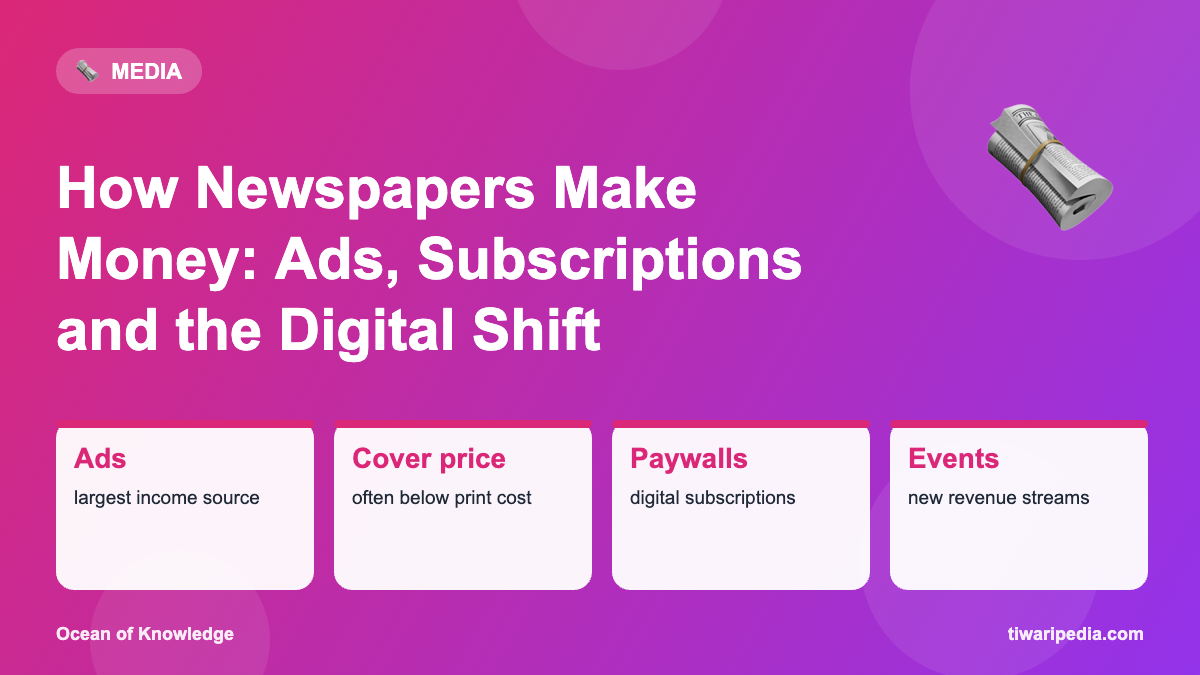
Main revenue streams
| Source | How it works |
|---|---|
| Display advertising | Brands buy space on pages, especially the front page and supplements |
| Classified ads | Matrimonial, jobs, property and public notices |
| Government ads | Tenders, public notices and campaigns (DAVP/CBC rates) |
| Circulation revenue | Cover price and home subscriptions |
| Digital subscriptions | Paywalls and e-paper plans |
| Events and conferences | Award shows, summits and sponsorships |
| Syndication | Selling articles and photos to other publications |
Why are Indian newspapers so cheap?
Publishers keep cover prices low to maximise circulation, because advertisers pay more to reach more readers. Higher, audited circulation (measured by the Audit Bureau of Circulations) and readership surveys help them charge higher ad rates.
The digital shift
- Print advertising has shrunk as ad budgets moved to Google, Meta and other platforms.
- Publishers now earn from website ads, video, newsletters and apps.
- Many have introduced paywalls or premium plans for in-depth journalism.
- Search and social media traffic is unpredictable, so loyal subscribers matter more.
Costs of running a newspaper
Newsprint (paper) is a major cost, along with printing plants, distribution to newspaper agents and hawkers, journalists’ salaries and technology. Newsprint prices rose sharply in recent years, pushing some publishers to cut pages or raise prices.
Why it matters to readers
When news depends heavily on advertisers, there can be pressure to avoid uncomfortable stories. Paying for journalism you trust supports independent reporting.
How newspaper ad rates are set
Print ads are usually priced per column-centimetre: the number of columns wide multiplied by the height in centimetres. Premium positions such as the front page, the back page, a wraparound “jacket” or a pull-out supplement cost much more. Rates also differ by edition and city, so a national brand pays more to appear in every edition than a local business advertising in one city.
Who earns from the cover price?
The few rupees a reader pays rarely go fully to the publisher. A part goes to the distribution chain: the agents who collect bundles from the printing press and the hawkers who deliver copies to homes early every morning. After these commissions, the publisher’s share of the cover price is small compared with the cost of newsprint, ink and printing.
The strength of Indian-language newspapers
India is one of the few large markets where print readership remains strong, especially for Hindi and other Indian-language papers. Regional dailies with many city editions reach readers in small towns where local news, local ads and morning home delivery are still part of daily life. Local advertisers such as coaching centres, jewellers, real estate firms and car dealers make these editions profitable.
Digital business models newspapers use
| Model | How it works |
|---|---|
| Free with ads | Articles are free; money comes from display and video ads |
| Metered paywall | A few free articles a month, then readers must subscribe |
| Freemium | News is free; premium analysis is for subscribers only |
| E-paper | A digital copy of the printed newspaper for a small fee |
| Newsletters and podcasts | Build loyal audiences and attract sponsors |
| Reader contributions | Readers voluntarily support journalism, a model used by The Guardian |
Internationally, The New York Times shows that subscriptions can work at scale: it now earns more from readers than from advertising, with millions of digital subscribers for news, games and cooking apps.
Challenges ahead
- Falling print advertising as brands move to digital platforms.
- High and volatile newsprint prices.
- AI search tools and social feeds answering questions without sending readers to news websites.
- Competition from free news on video platforms and messaging apps.
Audited circulation figures for Indian publications are published by the Audit Bureau of Circulations.
Revenue mix: print era vs digital era
| Revenue source | Print era | Digital era |
|---|---|---|
| Advertising | Main source by far | Still important, but shared with tech platforms |
| Reader payments | Small cover price | Subscriptions and memberships growing |
| Other income | Events and supplements | Events, newsletters, podcasts, licensing content |
How readers can support good journalism
- Subscribe to at least one publication you trust.
- Read and share original reporting rather than copied content.
- Report errors so publications can correct them.
- Check facts before forwarding news on messaging apps.
Key takeaways
- Advertising pays most of a newspaper’s bills.
- Low cover prices build circulation, which raises ad rates.
- Subscriptions and digital products are the future of the business.
Frequently asked questions
What is the main source of income for newspapers?
Advertising, both commercial and government, typically makes up the larger share of revenue.
What is a paywall?
A system that restricts access to online articles unless readers subscribe.
What is newsprint?
The cheap, thin paper used to print newspapers.
Keep exploring
Facts are based on widely accepted official, scientific and historical sources at the time of writing. Spotted something that needs updating? Let us know.
Related reading
Keep reading on Tiwaripedia
- How Does TV Broadcasting Work? Terrestrial, Cable, DTH and OTT Explained
- 10 Incredible Facts About Newspapers
- 10 Incredible Facts About Hollywood
- The History of Television in India: From Doordarshan to Streaming
- 10 Incredible Facts About Cartoons and Animation
More guides: All Media articles